
 中文
中文

What Types of Copper Are Used in AI Computing Centers?
The latest analysis from the International Energy Agency shows that global data center electricity consumption is expected to increase from approximately 485 TWh in 2025 to approximately 950 TWh by 2030, while the power demand of AI-specific data centers is growing even faster. Meanwhile, the rack power density of AI servers has increased significantly from 2020 to 2025 and continues to rise[1-3]. From a materials perspective, this change means that two load chains are strengthening simultaneously: one is the current path from the power grid to the chip, and the other is the heat flow path from the chip to the cooling medium. Copper is located at key nodes in both paths.
Therefore, before discussing “how much copper AI needs,” it is more important to first answer “what types of copper are used in computing centers, why they are used in these locations, which components require pure copper, and which components instead require copper alloys.” Only by matching product forms, microstructures, and service conditions can we avoid broadly classifying all copper components as high-purity copper or high-conductivity copper.
I. From the Perspective of Material Systems, AI Computing Centers Have Two Copper Paths
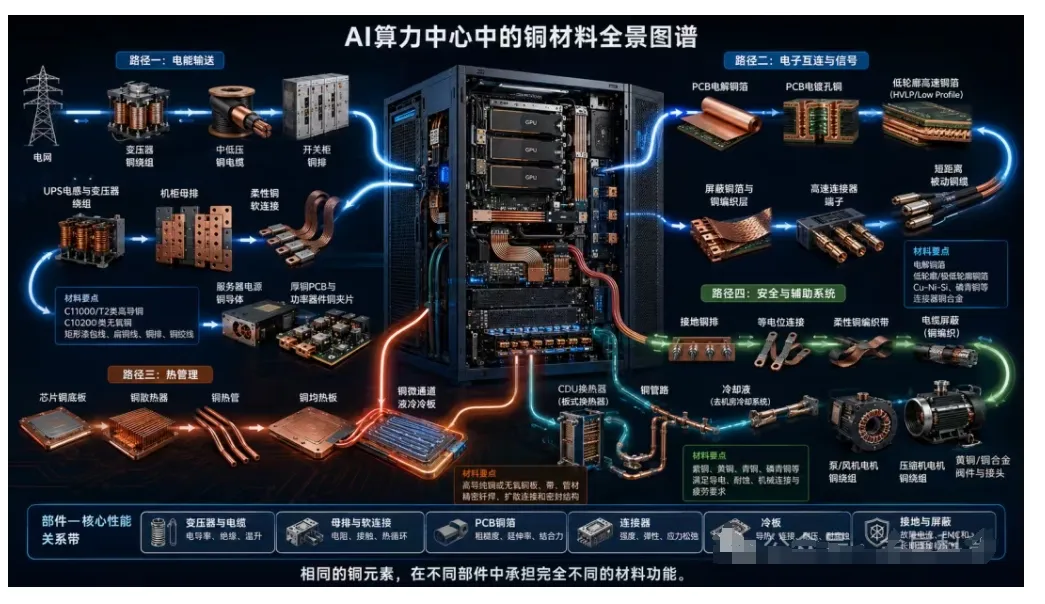
The copper used in computing centers can generally be divided into electrical energy transmission materials, power devices and electronic interconnection materials, thermal management materials, connection and elastic contact materials, as well as grounding and electromagnetic shielding materials. Although they are all based on copper, their performance objectives are not the same.
-
Current main path: Transformer windings—medium and low voltage cables—switchgear copper busbars—UPS and power modules—rack busbars—server-level power supply—chip packaging.
-
Heat flow main path: Chip interface—copper base plate or cold plate—microchannels—coolant—CDU heat exchanger—secondary-side cooling system.
-
Signal and control path: High-speed PCB copper foil, passive copper cables, connector terminals, shielding layers, and grounding conductors.
-
Mechanical reliability path: Busbar connection interfaces, flexible soft connections, elastic terminals, welding areas, crimping areas, and thermal cycling constraint locations.
These paths intersect with each other inside the equipment, but they cannot be evaluated using the same criteria. Busbars focus more on 20 ℃ resistivity, temperature rise, and contact interfaces; cold plates focus more on thermal conductivity, microchannel processing, sealing, and coolant compatibility; connector terminals focus more on strength, elasticity, stress relaxation, and coating stability.
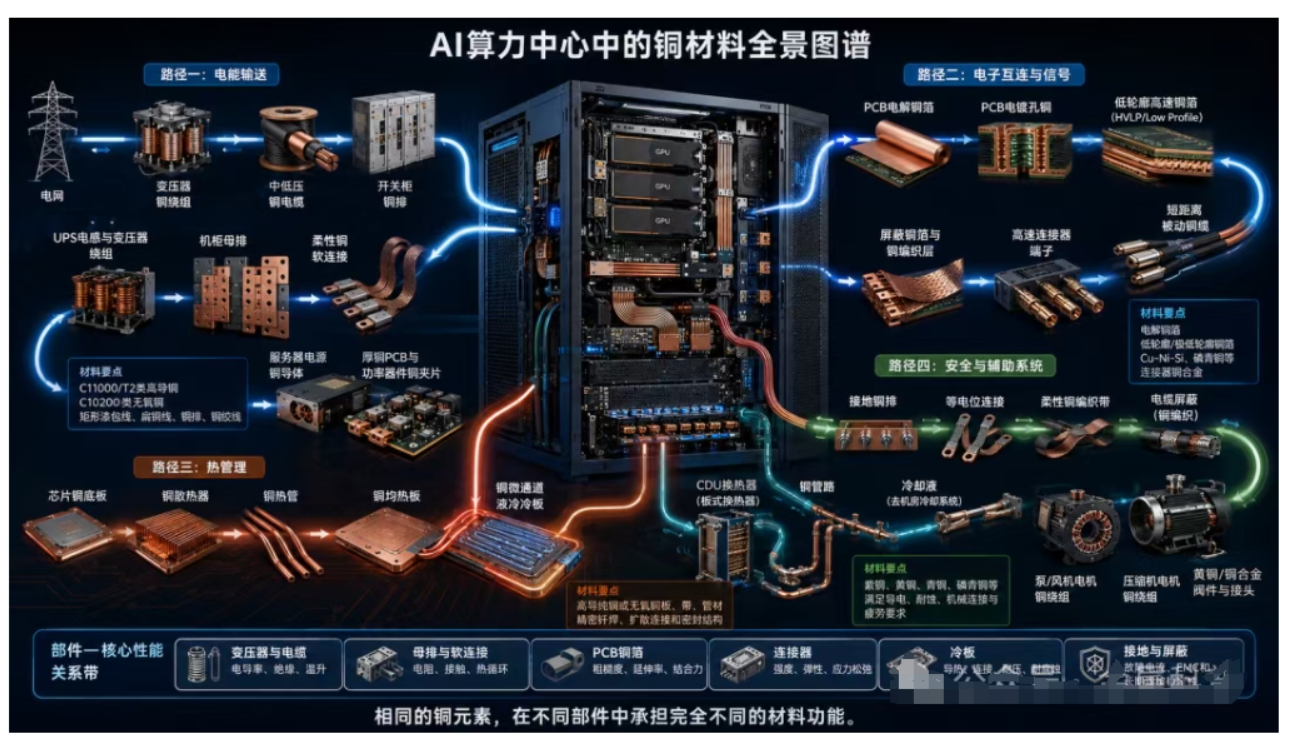
Figure 1 Copper Material Landscape in AI Computing Centers
II. Power Grid Entrance: Copper in Transformers, Switchgear, and Power Cables
1. Transformer Windings: High Conductivity Is Only the Foundation; Temperature Rise and Mechanical Stability Are Equally Important
The electricity used by computing centers first passes through transformation and distribution equipment. Transformer windings can use copper or aluminum. The advantages of copper are mainly reflected in its lower volume resistivity, higher volumetric power density, smaller conductor cross-section, and better layout capability when joint and winding dimensions are limited. For high-capacity equipment, space-constrained equipment, or applications with high short-circuit mechanical stress, copper windings can achieve a better balance between efficiency, temperature rise, and size.
The material forms are not limited to round wires. Medium and high-power equipment may use rectangular enameled wires, paper-wrapped flat copper wires, copper foil windings, or continuously transposed conductors. At this point, the evaluation object is no longer only copper purity, but also includes dimensional tolerance, corner quality, enamel film or paper insulation integrity, annealing condition, yield strength, and deformation resistance under short-circuit electromagnetic forces.
2. Cables and Busbars: Bulk Materials Are Still Mainly Based on High-Conductivity Electrolytic Copper
Medium and low voltage cables, bus ducts, switchgear busbars, and grounding bars from substations to data center rooms represent one of the largest copper consumption segments in computing centers. Most conventional conductors do not require 5N or 6N copper. C11000/T2-type high-conductivity electrolytic copper, copper rods, and copper wires that meet cable conductor resistance requirements can already satisfy the needs of most engineering applications. IEC 60228 and IEC 60364-5-52 specify requirements for conductor resistance, cross-sectional area, temperature rise, and installation conditions for cable conductors and low-voltage building wiring systems, respectively[14-16].
For busbars, material resistance is only part of the total resistance of the finished product. Bolted contact interfaces, coatings, surface flatness, overlap length, tightening force, and local current constriction may all create additional hot spots. ASTM B187/B187M includes C11000, C10200, C10100, and silver micro-alloyed pure copper as electrical busbar materials, indicating that there is no single unique grade for busbar selection[9-13].
III. UPS, Power Modules, and Rack Power Distribution: Copper Is Moving from “Large Cross-Section” Toward “Low Inductance”
AI servers do not directly use grid AC power. Electricity must also pass through UPS systems, rectifiers, DC/DC converters, battery backup systems, power shelves, and board-level power modules. At this level, copper exists not only as busbars, conductors, and windings, but also as power device substrates, lead frames, copper clips, and thick copper PCBs. As rack power increases, copper conductors must not only carry higher currents but also control parasitic inductance and electromagnetic interference.
The OCP Open Rack architecture has developed from traditional 12 V systems toward 48 V systems. Under the same power level, increasing voltage from 12 V to 48 V reduces current to one quarter of the original value, and conduction losses theoretically decrease significantly according to the I²R relationship. However, high-power racks may still require hundreds of amperes to kiloampere-level connections. OCP’s publicly available ORv3 interface solution has already introduced 1000 A-class output connectors, and NVIDIA rack-scale systems explicitly include power shelves, busbars, and liquid cooling manifolds[4-7].
At this level, high-conductivity pure copper is generally used for the main current path; areas requiring frequent assembly, thermal cycling, or higher temperature stability may use tin-plated copper, silver-plated copper, silver micro-alloyed copper, or flexible laminated busbars. High purity is not the only goal. Softening temperature, surface contact stability, and connection processes often determine long-term temperature rise more directly.
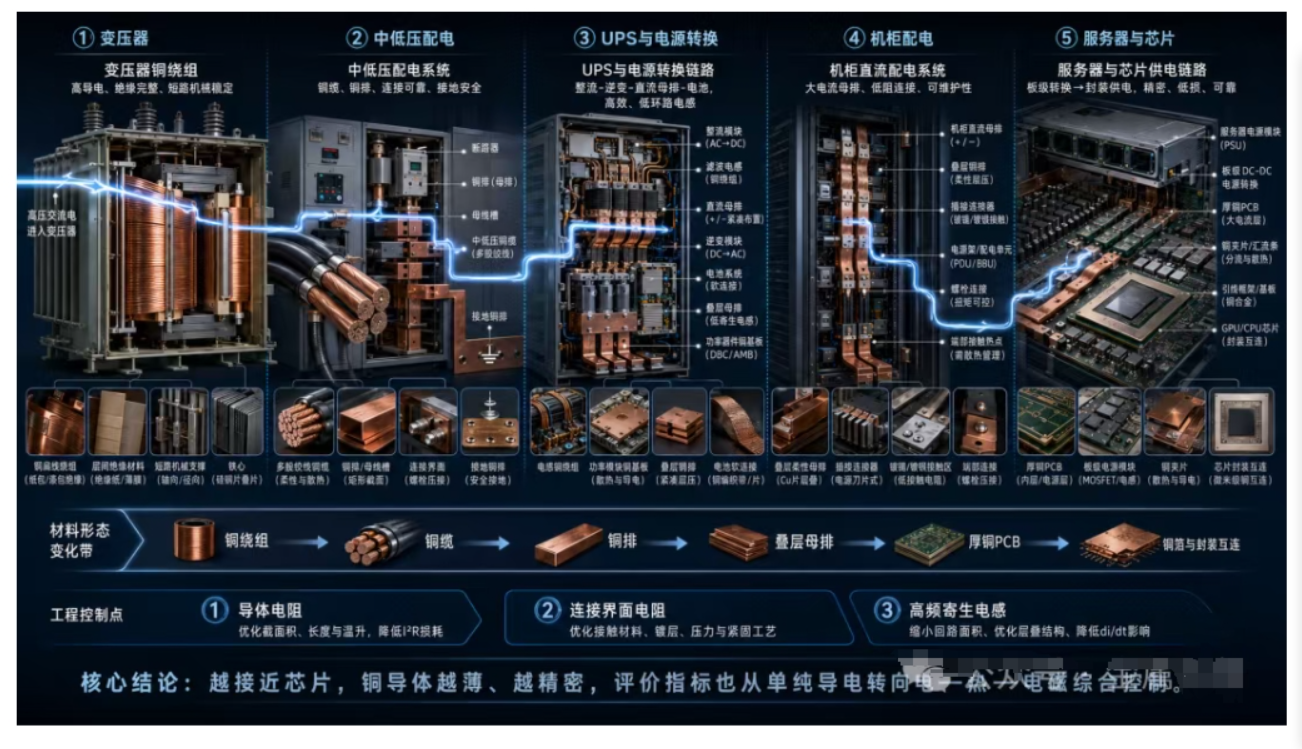
Figure 2 Copper Current Path from Transformer to Server Rack
IV. Inside Servers: PCB Copper Foils, Passive Copper Cables, and Copper Alloys in Connectors
1. PCB Copper Foil: Beyond High Conductivity, Surface Profile and Thermomechanical Reliability Must Also Be Controlled
Server motherboards, accelerator cards, switches, and power boards contain large amounts of electrolytic copper foil and electroplated copper. For power layers, the focus is on copper thickness, current-carrying capability, via copper reliability, and temperature rise; for high-speed signal layers, copper surface roughness increases conductor loss through the skin effect, making low-profile and very-low-profile copper foils and their surface treatments important components of high-speed PCB materials. IPC-4562B classifies metallic foils used for printed circuits, while IPC-6012F specifies qualification and performance requirements for rigid printed boards[17-19].
This means that evaluating copper foil used in servers cannot focus only on copper content. Foil grain structure, elongation, roughness, profile treatment, bonding strength with resin, and dimensional stability after lamination are equally important. Excessive surface roughness may improve mechanical bonding but increase high-frequency insertion loss; overly smooth surfaces require more precise chemical treatment to ensure interlayer bonding.
2. High-Speed Interconnection: Fiber Is Expanding, but Short-Distance Copper Connections Have Not Disappeared
Long-distance and high-bandwidth backbone links in data centers are increasingly adopting optical fiber, but large amounts of short-distance copper interconnects still exist inside racks, between boards, and within equipment. NVIDIA rack-scale systems use passive copper cables for connecting NVLink switches and computing units, demonstrating that high-density systems are not simply becoming “fully optical”[4].
The material focus of short-distance high-speed copper interconnects includes conductor cross-sectional consistency, surface quality, plating, differential pair geometric stability, and shielding structures. At this point, copper’s high electrical conductivity is only the foundation; structural precision and electromagnetic design often determine final signal integrity.
3. Connectors: What Is Truly Needed Is High-Strength High-Conductivity Copper Alloys
Connector springs, socket terminals, and high-speed interface contacts generally cannot directly use soft pure copper. Pure copper has high electrical conductivity, but insufficient yield strength, elastic retention, and high-temperature stress relaxation capability. Cu-Ni-Si alloys, phosphor bronze, and beryllium copper obtain higher strength and elasticity through precipitation strengthening or solid-solution strengthening. Among them, C70250 is commonly used for electronic connectors and contact springs, with typical electrical conductivity of approximately 35%–40% IACS, while providing high strength and stress relaxation resistance that pure copper cannot achieve simultaneously[26-28].
Therefore, the “copper” in computing centers is not only pure copper near 100% IACS, but also includes copper alloys that sacrifice part of electrical conductivity in exchange for long-term contact force. For connectors, contact pressure, gold plating or tin plating systems, substrate strength, and stress retention after thermal aging are more important than pursuing the highest electrical conductivity.
V. Liquid Cooling and Thermal Management: Copper Transfers Heat from Chips to Coolant
1. Copper Base Plates, Vapor Chambers, and Heat Pipes
In traditional air-cooled servers, copper has already been widely used in heatsink base plates, heat pipes, and vapor chambers. Copper base plates are responsible for evenly spreading local chip heat flux, while heat pipes and vapor chambers use phase change and capillary structures to achieve long-distance heat transfer. Such products often use high-conductivity pure copper or oxygen-free copper sheets, strips, and tubes, because the requirements involve not only thermal conductivity but also deep drawing, brazing, sealing, vacuum integrity, and internal capillary structure manufacturing.
Material hardness that is too high increases forming and sealing difficulties, while excessive softness may reduce the pressure resistance of thin-wall structures. Oxide films, surface contamination, and welding defects may affect vacuum lifetime. Therefore, heat pipes and vapor chambers are closer to integrated “material-forming-sealing” products rather than simply high-purity copper containers.
2. Liquid Cooling Cold Plates: Thermal Conductivity Is Only One Part of Cold Plate Performance
Direct liquid cooling cold plates usually place a copper base close to CPU, GPU, or accelerator packages and transfer heat to coolant through internal microchannels. Copper’s high thermal conductivity helps reduce spreading thermal resistance, decrease hotspots, and improve temperature uniformity, making copper cold plates an important solution for high heat flux applications. The OCP cold plate working group is promoting open specifications for single-phase direct cooling cold plates, coolants, and quick connectors. Current engineering systems must also consider flow distribution, pressure drop, corrosion, leakage, and maintenance[7,20-24].
Cold plate materials and manufacturing processes are not limited to a single approach. Common methods include machining or etching microchannels in copper plates followed by brazing or diffusion bonding, combining copper base plates with stainless steel or polymer covers, and copper-aluminum hybrid systems. The finer the microchannels, the larger the specific surface area, but requirements for clogging prevention, pressure drop control, and manufacturing consistency also become higher. Excessively high connection temperatures may cause matrix softening or grain growth, while residual brazing material, voids, and unbonded areas increase thermal resistance and introduce leakage risks.
Liquid cooling systems also involve material compatibility issues. When copper, aluminum, stainless steel, brass, and different elastomers coexist, coolant conductivity, pH value, dissolved oxygen, corrosion inhibitors, and temperature affect galvanic corrosion and deposition behavior. OCP-related coolant guidelines emphasize corrosion control under conditions involving high copper surface area and mixed metals[7,8]. Therefore, cold plates cannot only be evaluated by thermal conductivity and channel dimensions; they must also verify welds, pressure resistance, helium leak testing, corrosion, and long-term flow stability.
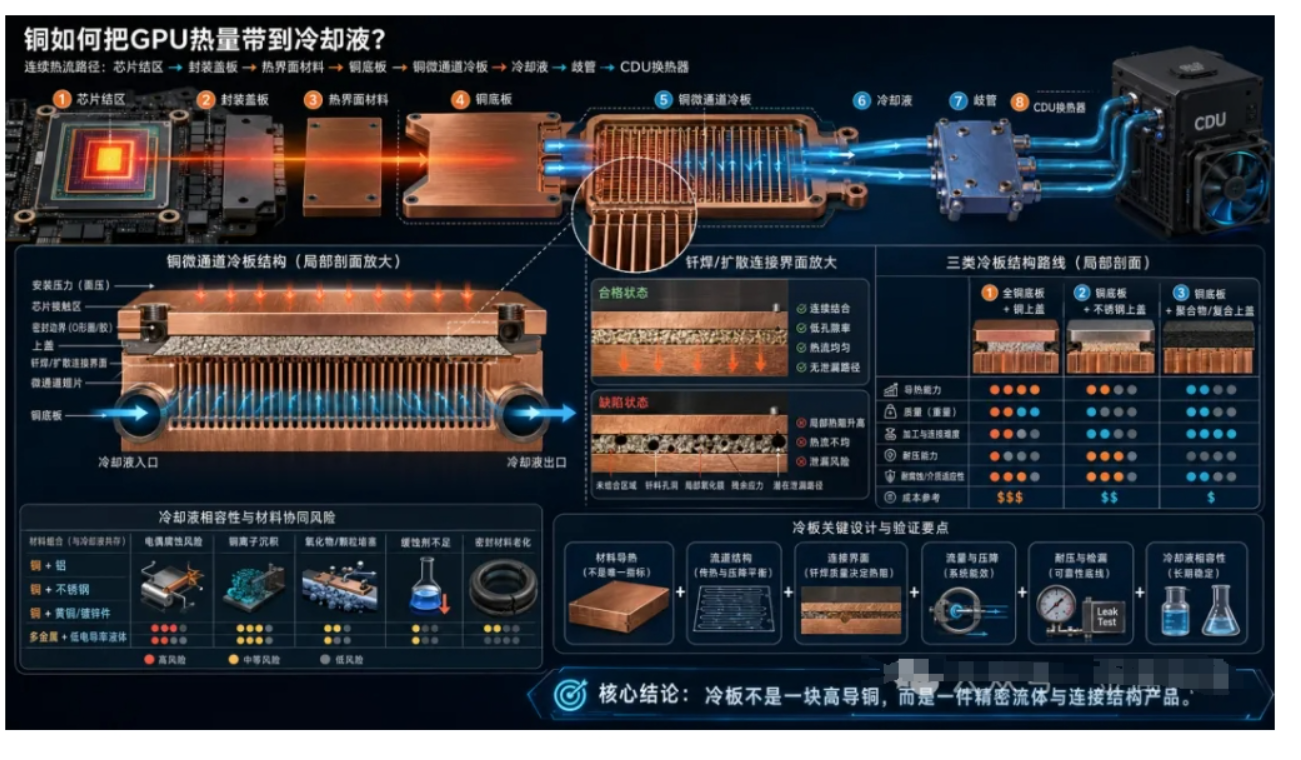
Figure 3 Copper Thermal Management Path and Cold Plate Material Structure in AI Servers
VI. Grounding, Shielding, and Auxiliary Equipment: Easily Overlooked Copper Consumption
AI computing centers also require large-area grounding grids, equipotential bonding, rack grounding bars, cable shielding layers, flexible braided straps, and inter-equipment bonding wires. These components do not directly participate in computing, but they determine fault current discharge, electromagnetic compatibility, and personnel safety. Grounding conductors commonly use bare copper, tin-plated copper busbars, or copper stranded wires; high-frequency shielding relies on copper foil, copper braided layers, and 360° termination structures.
In addition, motors in pumps, fans, compressors, electromagnetic valves, and CDUs also require copper windings. Heat exchangers and pipelines may also contain copper tubes, brass fittings, and copper alloy valves. For cooling systems, these components must undergo material compatibility evaluations together with coolants, sealing materials, and other metals.
VII. How Should the Main Copper Materials in AI Computing Centers Be Classified?
| Application Location | Typical Copper Materials / Product Forms | Key Performance | Material Selection Boundary |
|---|---|---|---|
| Transformers and inductors | High-conductivity copper round wires, enameled flat copper wires, copper foil windings | Electrical conductivity, temperature rise, dimensions, insulation, short-circuit mechanical strength | Both copper and aluminum can be used; copper has greater advantages when power density is high and space is limited |
| Cables, bus ducts, switchgear | C11000/T2-type high-conductivity copper, copper stranded wires, copper busbars | Resistance at 20 ℃, temperature rise, connection and installation conditions | Most applications do not require 5N copper; finished product resistance and connections are more important |
| UPS, power shelves, rack busbars | Hard or semi-hard copper busbars, laminated busbars, tin-plated/silver-plated copper | Current density, contact resistance, softening, low inductance | Mainly high-conductivity pure copper; silver micro-alloyed copper or surface coatings can be used locally |
| PCB and packaging | Electrolytic copper foil, electroplated copper, thick copper layers, copper clips | Copper thickness, surface roughness, via reliability, thermal cycling | High-speed signal layers cannot focus only on purity; low profile and interlayer bonding are equally important |
| Connectors and terminals | Cu-Ni-Si, phosphor bronze, beryllium copper, and other copper alloys | Strength, elasticity, stress relaxation, coating stability | Partial electrical conductivity can be sacrificed to maintain long-term contact force |
| Heat pipes and vapor chambers | High-conductivity pure copper or oxygen-free copper sheets and tubes | Thermal conductivity, forming, brazing, vacuum sealing | Material condition and cleanliness are more important than a single purity value |
| Liquid cooling cold plates | Copper plates, copper microchannels, copper/stainless steel or copper/polymer combinations | Thermal conductivity, flow resistance, sealing, pressure resistance, corrosion resistance | System-level verification of coolant compatibility and welding quality is required |
| Grounding and shielding | Bare copper, tin-plated copper busbars, copper stranded wires, copper braided layers | Fault current capability, corrosion resistance, low-impedance termination | Mechanical installation and continuity must be accepted together with material performance |
VIII. Four Issues That Materials Research and Industrialization Truly Need to Solve
1. Moving from “Grade Qualification” to “Finished Product Performance Qualification”
Copper material grade is only the starting point. Busbars need to be tested for finished-product micro-ohm resistance and rated current temperature rise; cold plates need to be tested for thermal resistance, flow resistance, pressure resistance, leakage detection, and corrosion; connectors need to be tested for contact resistance, insertion and withdrawal cycles, vibration, and stress relaxation after thermal aging; PCB copper foils need to verify roughness, bonding strength, and high-speed loss.
2. Moving from Single Electrical Conductivity to Electrical-Thermal-Mechanical Multi-Performance Balance
The advantages of pure copper are high electrical conductivity and high thermal conductivity, but insufficient softening resistance, creep resistance, strength, and elasticity may limit certain components. Copper alloys reduce electrical conductivity but improve terminal retention force, thermal softening resistance, and fatigue life. Material evaluation must focus on service functions rather than uniformly pursuing the highest IACS value.
3. Moving from Bulk Materials to Interface and Manufacturing Defect Control
Hot spots and failures in computing centers often occur at interfaces: busbar joints, crimping points, weld seams, cold plate bonding layers, PCB vias, connector coatings, and coolant contact surfaces. Voids, oxide films, roughness, residual stress, and local thinning can quickly eliminate material advantages.
4. Moving from Individual Laboratory Performance to Batch Consistency and Supply Capability
The demand for copper in AI infrastructure is reflected not only in total quantity but also in large-scale consistency. Copper rod cleanliness, copper foil profile stability, busbar dimensional and coating consistency, cold plate channel processing, and leak detection capability all determine whether products can maintain the same temperature rise and reliability during large-scale rack deployment.
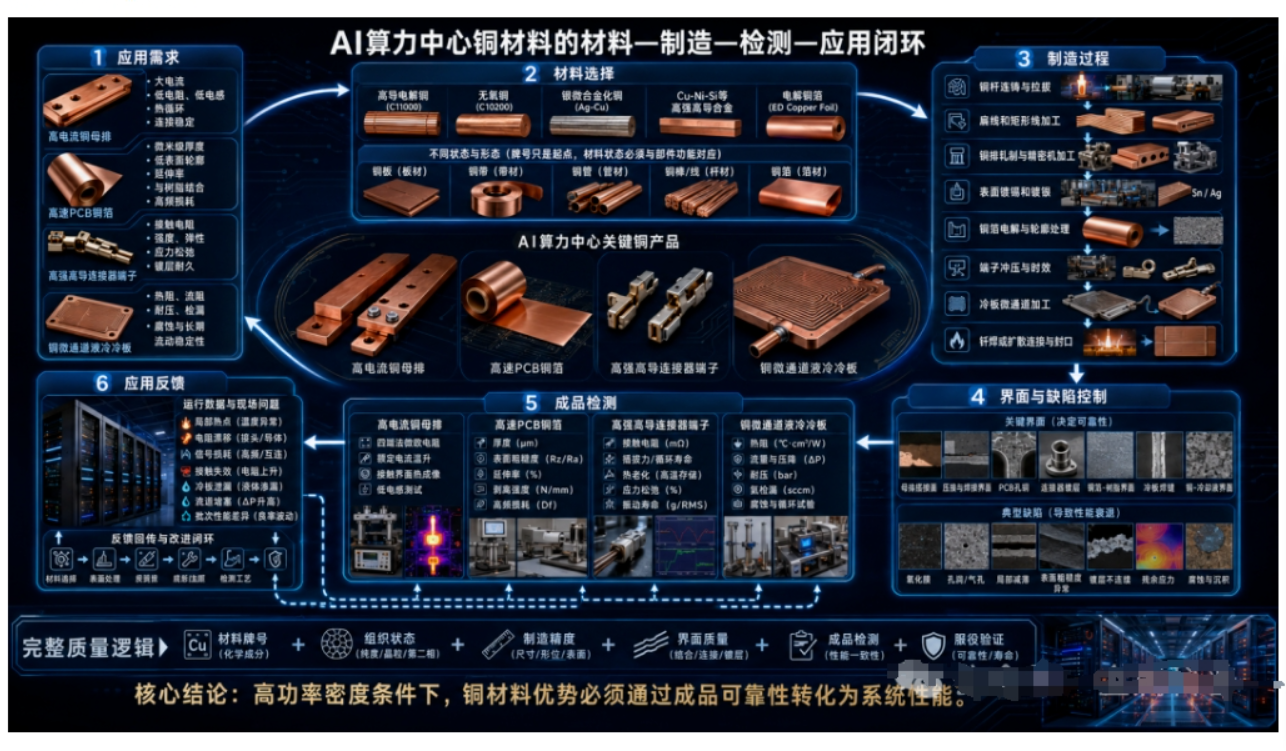
Figure 4 The “Material-Manufacturing-Testing-Application” Closed Loop of Copper Materials in AI Computing Centers
IX. Conclusion: AI Does Not Need One Type of Copper, but a Complete Copper Material Capability System
From transformers to server racks, from PCB copper foils to liquid cooling cold plates, copper in AI computing centers covers millimeter-scale cables and busbars, micron-scale copper foils and microchannels, as well as elastic terminals relying on precipitation strengthening. They share the advantages of copper’s high electrical conductivity and thermal conductivity, but face completely different manufacturing and service conditions.
Large-scale power transmission and busbars still mainly use mature high-conductivity copper; oxygen-free copper is suitable for components more sensitive to low oxygen content, welding, sealing, and cleanliness; connectors require high-strength high-conductivity copper alloys; high-speed PCBs require low-profile copper foils; liquid cooling systems require copper substrates, flow channel structures, connection interfaces, and coolant compatibility to be evaluated within the same system.
Therefore, the demand brought by AI infrastructure is not simply a demand for “high-purity copper,” but a new classification of copper material capabilities across the entire process chain: raw material cleanliness, continuous processing, thin strip and foil control, precision forming, surface treatment, welding and connection, microchannel manufacturing, and finished product reliability verification. Missing any one of these capabilities may eventually transform into temperature rise, energy loss, leakage, or signal failure under high power density conditions.
References and Standard Materials
[1] International Energy Agency. Key Questions on Energy and AI. Paris: IEA, 2026.
[2] International Energy Agency. Energy and AI. Paris: IEA, 2025.
[3] Lawrence Berkeley National Laboratory. 2024 United States Data Center Energy Usage Report. U.S. Department of Energy, 2024.
[4] NVIDIA. DGX GB200/GB300 Rack Scale Systems User Guide: Hardware Architecture, 2026.
[5] Open Compute Project. Open Rack V3 Base Specification and Power Architecture.
[6] Open Compute Project. ORv3 Power Output Connector / BB1000 Connector Technical Information.
[7] Open Compute Project. Cooling Environments: Cold Plate Workstreams and Single-Phase Direct-to-Chip Cold Plate Base Specification.
[8] Open Compute Project. Guidelines for Water- and Propylene-Glycol-Based Heat Transfer Fluids in Single-Phase Cold-Plate Racks, 2024-2025.
[9] Copper Development Association. UNS C11000 Electrolytic Tough-Pitch Copper Alloy Database.
[10] Copper Development Association. UNS C10200 Oxygen-Free Copper Alloy Database.
[11] Copper Development Association. UNS C10100 Oxygen-Free Electronic Copper Alloy Database.
[12] Copper Development Association. UNS C10700 Oxygen-Free Silver-Bearing Copper Alloy Database.
[13] ASTM B187/B187M-26. Standard Specification for Copper Bar, Bus Bar, Rod, and Shapes and General Purpose Rod, Bar, and Shapes.
[14] ASTM B152/B152M-24. Standard Specification for Copper Sheet, Strip, Plate, and Rolled Bar.
[15] ASTM B193-25. Standard Test Method for Resistivity of Electrical Conductor Materials.
[16] IEC 60228:2023. Conductors of Insulated Cables.
[17] IEC 60364-5-52:2009+A1:2024. Low-Voltage Electrical Installations—Selection and Erection of Wiring Systems.
[18] ISO/IEC 11801-5:2017. Information Technology—Generic Cabling for Customer Premises—Data Centres.
[19] IPC-4562B. Specification for Metal Foil for Printed Wiring Applications, 2023.
[20] IPC-6012F. Qualification and Performance Specification for Rigid Printed Boards, 2024.
[21] Wu Z, et al. A Comprehensive Review of Cold Plate Liquid Cooling Technology for Data Centers. Chemical Engineering Science, 2025, 310: 121525.
[22] Zhou F, et al. Microchannel Heat Sinks for Cold Plate Liquid Cooling in Data Centers: Advances, Evaluations and Prospects. Renewable and Sustainable Energy Reviews, 2026, 230: 116729.
[23] Tuckerman D B, Pease R F W. High-Performance Heat Sinking for VLSI. IEEE Electron Device Letters, 1981, 2(5): 126-129.
[24] Azarifar M, et al. Liquid Cooling of Data Centers: A Necessity Facing Challenges. Applied Thermal Engineering, 2024.
[25] Deng Z, et al. Numerical and Experimental Study on Cooling High-Power Chips of Data Centers Using a Double-Side Cooling Module Based on a Mini-Channel Heat Sink. Applied Thermal Engineering, 2023.
[26] Hu H, et al. Experimental Investigation of Roll-Bond Liquid Cooling Plates for Server Chip Heat Dissipation. Applied Thermal Engineering, 2023.
[27] Copper Development Association. UNS C70250 Cu-Ni-Si Alloy Database: Electronic Connectors and Contact Springs.
[28] Copper Development Association. UNS C52100 Phosphor Bronze Alloy Database.
[29] ASTM B888/B888M. Standard Specification for Copper Alloy Strip for Use in Manufacture of Electrical Connectors or Spring Contacts.
[30] IPC APEX EXPO Technical Literature. Copper Foil Surface Roughness, Signal Transmission Loss and High-Speed Printed Boards, 2012-2024.
[31] ASHRAE TC 9.9. Liquid Cooling Guidelines for Datacom Equipment Centers, 2nd ed.
[32] Copper Development Association. The Copper Advantage in High-Density Data Center Cooling, 2026.
-
Tel:
-
E-mail:
-
Address:
No.1 Chengxi West Road, Cicheng, Ningbo, China
-

Ms.Yu
-

Ms.Sun