 中文
中文

High-End Copper Foil Classification Analysis: Technical Characteristics, Application Scenarios and Industry Trends
High-end copper foil, as a core basic material in the electronic information and new energy industries, directly affects the signal transmission efficiency, energy density, and reliability of downstream products. With the rapid development of areas such as 5G communication, artificial intelligence, and new energy vehicles, the classification standards and technical requirements for high-end copper foil are becoming increasingly detailed. This article combines industry standards and the latest market data to systematically classify high-end copper foil from four dimensions: manufacturing process, physical characteristics, surface treatment, and application fields, and analyzes its technical characteristics and industry trends.
Classification by Manufacturing Process
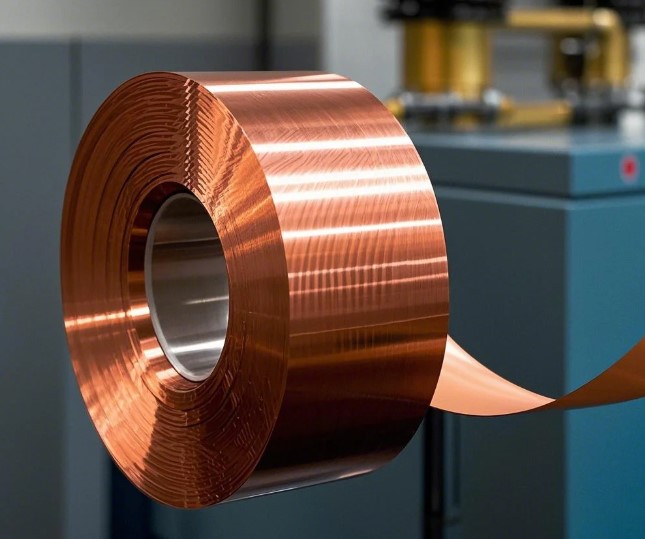
Based on the manufacturing process, high-end copper foil primarily includes two categories: electrolytic copper foil and rolled copper foil.
Electrolytic copper foil is made through electrochemical deposition, which is cost-effective and accounts for about 90% of the global copper foil market. It has a columnar grain structure, with high tensile strength but poor flexibility, making it suitable for rigid circuit boards. The typical surface roughness is about 7-8μm, requiring special treatment to reduce signal loss.
High-end products, such as ultra-low profile copper foil (HVLP) with a roughness ≤2.5μm, are used in high-frequency scenarios like 5G base stations and AI servers. The HVLP 5th generation copper foil used by Nvidia's Rubin platform even has a roughness ≤0.3μm; reverse-treated foil (RTF) reduces roughness through reverse processing, with the technology having evolved to 5th generation, and companies like Defu Technology achieving mass production.
In contrast, rolled copper foil is produced through physical rolling processes, has a fibrous grain structure, and offers excellent flexibility, with bending resistance of up to tens of thousands of times. It is suitable for flexible circuit boards (FPC), has high surface smoothness (Rz≤1.1μm), purity ≥99.9%, and slightly better electrical conductivity than electrolytic copper foil.
High-end products like high-temperature anti-oxidation glossy foil can withstand temperatures above 200℃ and are used in aerospace and high-temperature electronic equipment. Blackened/red-treated rolled copper foil enhances electromagnetic shielding performance, applicable to high-end consumer electronics and automotive electronics.
Classification by Thickness and Physical Characteristics
From the perspective of thickness and physical characteristics, high-end copper foil can be divided into ultra-thin peelable copper foil, high-power thick copper foil, and high-frequency high-speed low-loss copper foil.
Ultra-thin peelable copper foil typically ranges in thickness from 3-12μm. For instance, Defu Technology's 3μm carrier peelable copper foil needs to address strength and peel reliability issues under ultra-thin conditions. It was once monopolized by Japan's Mitsui, but now domestic companies have achieved sample verification. It is mainly used in IC packaging substrates, 2.5D/3D advanced packaging technology, supporting chip miniaturization and high-density integration.
High-power thick copper foil with a thickness ≥70μm (2 ounces) can carry high current and resist high-temperature oxidation. Taking 18μm brass/nickel copper foil as an example, it requires high electrical and thermal conductivity (conductivity ≥100% IACS), peel strength ≥1.5N/mm, and is used in new energy vehicle electric drive systems and power modules for energy storage devices.
High-frequency high-speed low-loss copper foil needs to meet technical parameters such as roughness ≤2.5μm and dielectric loss (Df) ≤0.002. For example, Advanced Copper Foil's BF-TZA series is suitable for PTFE substrates, mainly used in 6G communication and high-speed data centers, with a single AI server's usage being 8 times that of a traditional server.
Classification by Surface Treatment and Function
Based on surface treatment and functional differences, high-end copper foil includes types such as double-sided glossy copper foil and composite copper foil.
Double-sided glossy copper foil has a roughness ≤1.3μm on both sides. Jiayuan Technology's related products have been certified by Nvidia, used in high-end HDI boards, and are suitable for smartphone motherboards and wearable device flexible circuits.
Composite copper foil includes technologies such as copper-aluminum composite foil and PET composite foil. Copper-aluminum composite foil combines copper's conductivity with aluminum's lightweight advantage, reducing costs by 30%, and is used in consumer electronics batteries. PET composite copper foil adopts a "sandwich" structure (metal – PET – metal), reducing copper usage by 70%, significantly improving safety and energy density. Sanfu New Tech's yield target is 95%. It is estimated that the global composite copper foil market will exceed 10 billion yuan by 2030, clearly indicating a trend of replacing traditional copper foil.
Classification by Application Fields
In terms of application fields, high-end copper foil performs prominently in the PCB and lithium battery sectors.
In the PCB field, the global high-end PCB copper foil market scale was about 6.312 billion yuan in 2024, and it is expected to reach 7.94 billion yuan by 2030, with a compound annual growth rate of 3.9%. The technology is evolving towards lower roughness (HVLP 5th generation ≤0.3μm) and thinner thickness (below 3μm), with concurrent upgrades in electrolytes and equipment.
In the lithium battery field, copper foil is classified by thickness into ultra-thin (≤6μm), super-thin (6-12μm), and thin (12-18μm) categories. In 2022, the top 5 domestic companies (e.g., Longdian Huaxin, Defu Technology, Nord Shares) accounted for 54.3% of lithium battery copper foil shipments. In terms of technological breakthroughs, Tongguan Copper Foil's 4.5μm ultra-thin lithium battery copper foil has achieved commercial application, and Jiangtong Copper Foil's Shangrao base plans an annual output capacity of 100,000 tons.
Environmental Protection and Industry Trends
In the aspects of environmental protection and industry trends, the high-end copper foil industry is moving towards lead-free and green manufacturing, and the process of domestic substitution is accelerating.
The EU RoHS directive and China's "Electronic Industry Water Pollutant Discharge Standard" (GB 39731-2020) strictly limit heavy metal emissions, prompting companies to adopt chromium-free passivation and wastewater reuse systems. Examples include Jiangxi Nord Copper Foil's project treating exhaust gases through "SNCR denitration + bag dust removal" and handling chromium-containing wastewater as hazardous waste after evaporation and concentration.
In terms of domestic substitution, in 2023, the domestic high-end PCB copper foil market share was only 5%, but it is expected to reach 15% by 2030, corresponding to a scale of 5.4 billion yuan. Tongguan Copper Foil's HVLP foil has completed customer validation, Hengtong Group's rolled copper foil has entered the aerospace supply chain, and companies with core technology and large-scale production capabilities will dominate market development.
Summary
The classification system of high-end copper foil reflects the electronics information and new energy industries' extreme pursuit of material performance.
From the fine surface treatment of electrolytic copper foil to the high flexibility design of rolled copper foil, from the technological breakthroughs of ultra-thin copper foil to the disruptive innovation of composite copper foil, the industry is rapidly evolving along the path of "thinness, low loss, and high reliability."
With the acceleration of domestic substitution and the improvement of environmental standards, companies with core technology and large-scale production capabilities will dominate the market, driving the high-end copper foil industry towards higher quality development.
-
Tel:
-
E-mail:
-
Address:
No.1 Chengxi West Road, Cicheng, Ningbo, China
-

Ms.Yu
-

Ms.Sun