
 中文
中文

Copper Demand in the Low-Altitude Economy
The low-altitude economy, a representative of China's emerging "new quality productive forces," is transitioning from policy planning to large-scale commercialization. Operating primarily in airspace below 1,000 meters, this sector encompasses diverse applications such as drone logistics, eVTOL (electric vertical take-off and landing aircraft) passenger transport, precision agriculture, and emergency rescue.
Amid this economic transformation—"expanding from the ground to the sky"—copper, with its exceptional electrical conductivity, thermal conductivity, and corrosion resistance, has emerged as a core material supporting the growth of the low-altitude economy. This report explores the underlying logic and future trends of copper demand in the sector, analyzed through the lenses of technological applications, market size, industrial chain development, and policy drivers.
Core Applications of Copper in the Low-Altitude Economy
Aircraft Power Systems
Both drones and eVTOLs rely on high-purity copper (conductivity ≥ 58 MS/m) in their motors for efficient energy conversion. For example, DJI's high-end drones utilize oxygen-free copper windings, which reduce resistance by 15% compared to standard copper and improve motor efficiency by 8%, extending battery life by 12%.
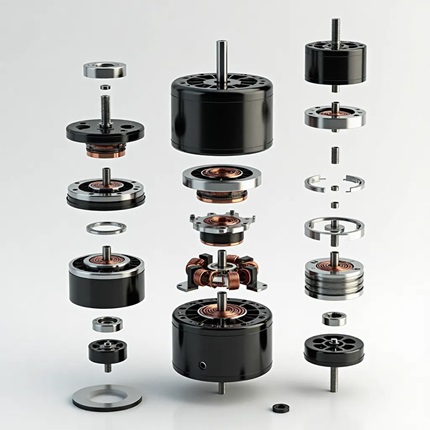
eVTOL motors, which require 3–5 times higher power density than drones, use specialized copper alloys. Germany's Volocopter, for instance, employs copper-nickel alloy windings that maintain high conductivity at temperatures up to 180°C.
In lithium batteries, copper is used in current collectors, flexible connectors, and heat dissipation modules. CATL's aviation-grade battery features copper foil as thin as 6μm that withstands 200A+ instantaneous currents, with copper alloy heat sinks keeping temperatures under 45°C. Next-gen semi-solid batteries utilize 3D copper foam, reducing copper usage to one-seventh of traditional foil while increasing energy density by 15%.
Low-Altitude Infrastructure
General aviation airports require high-capacity copper cables (≥50mm² cross-section) to support eVTOL fast charging (80kWh per cycle). In Suzhou's low-altitude grid pilot (300m coverage), copper cables total over 200 km, with annual demand exceeding 1,200 tons.
5G-A base stations use copper alloy waveguides for microwave transmission, offering 30% less signal loss than aluminum. In China's BeiDou ground enhancement system, each station consumes 1.2 tons of precision copper cabling.
Intelligent Devices
Drone flight control systems, camera sensor coils, and eVTOL autopilot modules all rely on copper alloy flexible flat cables (FFC) for data transmission—capable of 100,000+ bending cycles with less than 5% resistance fluctuation.
While aluminum alloys comprise over 50% of airframe weight, key load-bearing parts—like landing gear pivots and rotor shafts—still require copper-based composites. For example, Chuzhou Jiangsu New Material's copper-nickel-silicon pivot offers 40% more strength than pure copper while reducing weight by 25%.
Market Size and Growth Logic
Market Size
China's low-altitude economy is projected to reach 1.5 trillion RMB by 2025, and over 3.5 trillion RMB by 2035, with a CAGR above 22%. Drones, eVTOLs, and infrastructure account for over 70% of related copper demand.
As of 2023, China had 1.267 million registered drones, expected to surpass 26 million by 2030. At 15kg of copper per industrial-grade drone, annual incremental demand would be ~39,000 tons. For logistics drones (25kg copper per unit), with a projected 30% share, demand would increase by another 19,500 tons.
The eVTOL market reached 980 million RMB in 2023, with projected production exceeding 12,000 units by 2030. At 70kg of copper per eVTOL, that equates to 840 tons, or 3,840 tons including supporting infrastructure.
Over 500 new general aviation airports are expected nationwide before 2025, driving annual copper demand from charging and communications infrastructure to over 100,000 tons.
Growth Drivers
Government policies such as the National Integrated Three-Dimensional Transportation Network Plan and the General Aviation Innovation Application Implementation Plan (2024–2030) have established low-altitude economy as a national strategy.
Technological breakthroughs—including CATL's condensed-state battery (energy density >500Wh/kg) and high-efficiency motors (5kW/kg using NdFeB magnets)—are driving copper usage. For every additional 10kWh in eVTOL batteries, 15kg of copper is needed.
The sector is also expanding into smart city management (e.g., drone inspections), precision agriculture (e.g., drone spraying in Xinjiang cotton fields), and emergency response (e.g., intercity medical deliveries), all with exponential copper demand.
Industrial Chain Deployment
Upstream Resources
China relies on imports for over 80% of copper concentrate, mainly from Chile and Peru. In 2024, global copper ore grades dropped to 0.44%, with mining costs rising to $17,700/ton, creating long-term supply constraints.
Recycled copper tech, including AI sorting and vacuum refining, can produce 99.997% purity. Each ton of recycled copper reduces CO₂ emissions by 4.2 tons. Recycled copper is expected to reach 15% usage share in the sector by 2030, but primary copper will dominate short-term.
Midstream Materials
Key materials include Chuzhou Jiangsu's copper-nickel-silicon alloys and Ningbo Jintian Copper's PEEK rectangular wires—used in drone connectors and eVTOL motors—offering conductivity and tensile strength >600MPa.
3D copper foam for semi-solid battery collectors cuts copper usage by 85% and boosts energy density by 20%. Sanfu New Material and Dongfeng Group have delivered at scale, with a major battery client accounting for over 30% of orders.
Downstream Applications
Suzhou's drone logistics network uses copper-based fast-charging, reducing delivery costs by 40% and supporting 20,000 deliveries/day. Each logistics drone uses ~18kg of copper annually, adding 360 tons/year to demand.
Shenzhen–Zhuhai's eVTOL route uses copper-composite charging interfaces with 5-minute rapid charging. Each port supports over 10,000 uses/year, tripling lifespan over standard connectors.
Supply Chain Risks
Nationalization policies in copper-rich nations like Chile and Peru could cause supply volatility. For instance, a 2024 miners' strike in Chile raised global copper prices by 12% in one week.
Though aluminum now accounts for 20% of non-critical components, over 90% of key parts (motor windings, connectors) remain irreplaceable by copper.
Policy Support and Regional Practices
National Policy Support
The 2024 Government Work Report officially listed the low-altitude economy as a new growth driver. Key regions like the Yangtze River Delta and Greater Bay Area are seeing copper demand rise at 25%+ CAGR.
The Civil Aviation Authority's new performance standards for UAV identification systems have led to standardized copper cabling, reducing per-unit copper usage by 15%.
Regional Pilots
-
Shenzhen: Introduced China's first low-altitude economic regulation; plans 500 UAV vertiports by 2025, with supporting copper cable length exceeding 500km, and annual copper demand surpassing 3,000 tons.
-
Hefei: Launched a 2-billion RMB industry fund to support eVTOL copper alloy R&D, targeting 60%+ local copper sourcing by 2027.
-
Ningbo: Testing a low-altitude safety corridor with copper-intensive telecom and navigation systems, improving signal stability by 20% with annual copper demand of ~800 tons.
Future Trends and Investment Opportunities
Demand Forecast
Drone logistics and agricultural applications will dominate copper usage, adding 120,000–150,000 tons/year by 2030—5–8% of global growth. eVTOL scale-up and infrastructure buildout could raise this to 200,000–250,000 tons/year, or 10–12%.
As low-altitude tech integrates with smart city infrastructure, copper demand will stabilize, maintaining a CAGR of 8–10%.
Technological Innovation
Developing high-strength copper alloys (e.g., Cu-Cr-Zr >500MPa) and high-conductivity composites (thermal conductivity ≥ 380W/m·K) is crucial for high-temp and high-vibration environments.
Establishing a closed-loop recycled copper ecosystem for low-altitude aircraft could raise recycled copper use to 30% by 2030, reducing dependence on virgin materials.
Investment Opportunities
-
Aviation-grade copper alloys: e.g., Ningbo Jintian Copper (eVTOL motor wires)
-
High-capacity copper cables and smart charging: e.g., Zhongtian Tech, TGOOD (Teld)
-
Foam copper and copper composites: e.g., Sanfu New Material, Dongfeng Group
-
Tel:
-
E-mail:
-
Address:
No.1 Chengxi West Road, Cicheng, Ningbo, China
-

Ms.Yu
-

Ms.Sun