
 中文
中文

Copper-Clad Aluminum: Why Is It an Engineering Material in Coaxial Cables but Highly Controversial in Ethernet Cables?
Note: This article no longer repeats the general discussion of whether “aluminum can replace copper.” Instead, it focuses on why copper-clad aluminum receives different evaluations in different electrical application scenarios. The term “standard-compliant copper-clad aluminum” used in this article refers to bimetallic conductors with publicly specified material structures, copper layer ratios, electrical resistance, and mechanical properties according to relevant standards. Using copper-clad aluminum while falsely labeling it as pure copper is a product identification and compliance issue, which is not included in normal material comparisons.
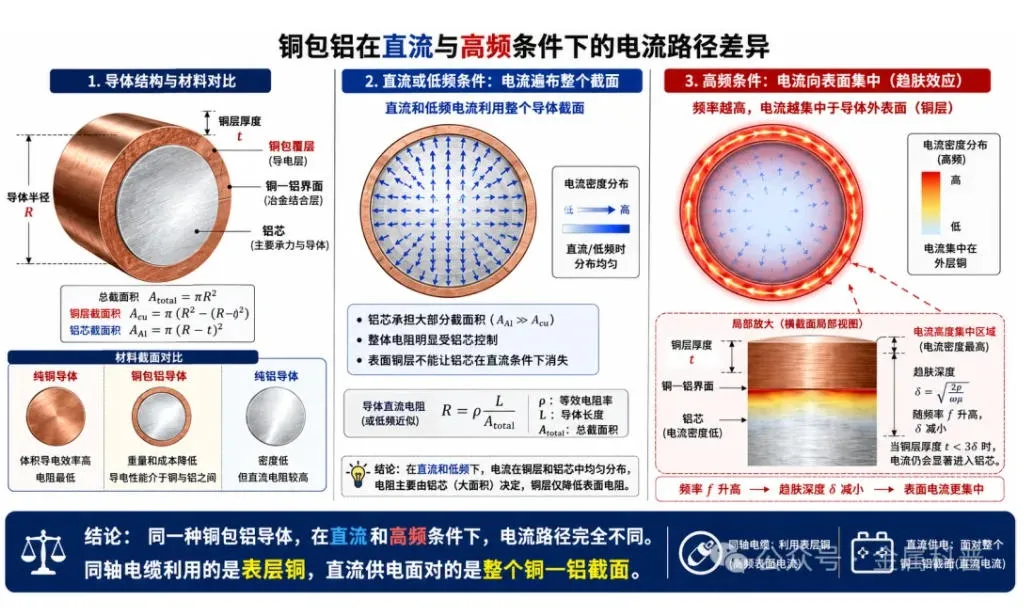
The same copper-clad aluminum wire can be a reasonable lightweight center conductor in coaxial cables, yet it is often regarded as a non-compliant material when used in so-called “Cat 5e” or “Cat 6” Ethernet cables. On the surface, this appears to be a difference in industry standards; however, the deeper reason is that these two types of products utilize completely different current paths.
Copper-clad aluminum (CCA) is not simply an aluminum wire coated with a layer of copper color. It is a bimetallic conductor composed of an aluminum core and a continuous copper cladding layer. ASTM B566 classifies CCA according to copper volume fraction and temper conditions into categories such as 10A, 15A, 10H, and 15H, and requires continuous bonding between the copper layer and aluminum core while meeting requirements for electrical resistivity, tensile strength, and elongation [1].
This means that CCA itself is a standardized engineering material. However, having a standard does not mean it can be applied to every type of cable. Whether a material is suitable depends on whether current flows mainly through the surface or the entire cross-section, whether the product carries DC power, and whether the corresponding standards explicitly allow its use.
Materials do not have inherently high-end or low-end classifications; the same composite conductor can lead to completely different conclusions when placed in different current paths and standard systems.
1. The Core Value of Copper-Clad Aluminum: Not Replacing Copper, but Redistributing Material Functions
The basic concept of CCA is straightforward: placing highly conductive and easily contactable copper on the outer layer while allowing low-density and lower-cost aluminum to occupy most of the cross-section. This reduces weight and copper consumption while retaining some advantages of copper surfaces in welding, electrical contact, and high-frequency transmission.
However, the overall performance of CCA does not automatically equal “the conductivity of copper + the lightweight advantage of aluminum.” For DC or low-frequency current, current flows through the entire conductor cross-section, meaning the proportion of aluminum in the core determines the overall resistance. For higher-frequency AC signals, current gradually concentrates near the conductor surface, and the contribution of the copper layer becomes more significant.
| Operating Condition | Main Current / Load Characteristics | Actual Performance of CCA | Products Requiring Attention |
|---|---|---|---|
| DC / Low frequency | Current utilizes the entire cross-section | Aluminum core dominates, and resistance is significantly higher than same-size pure copper | Power cables, PoE, low-frequency windings |
| Medium and high frequency | Current gradually concentrates toward the surface | The copper outer layer plays a greater role, but performance still depends on copper thickness and frequency | RF applications, some coaxial center conductors |
| Termination areas | Current must pass through connection interfaces | Copper surface helps contact performance, but cutting, crimping, or welding may expose aluminum core | Connectors, solder joints, crimp terminals |
| Thermal aging | Copper-aluminum interface experiences diffusion and stress changes | Intermetallic compounds and creep may alter resistance and mechanical properties | High-temperature and long-term current-carrying applications |
Therefore, CCA is not “low-cost pure copper,” but rather a composite conductor that utilizes functional separation between the outer layer and the core. It only has material value when the product design can truly take advantage of this division of roles.

2. Why Can Copper-Clad Aluminum Be Reasonably Used in Coaxial Cables?
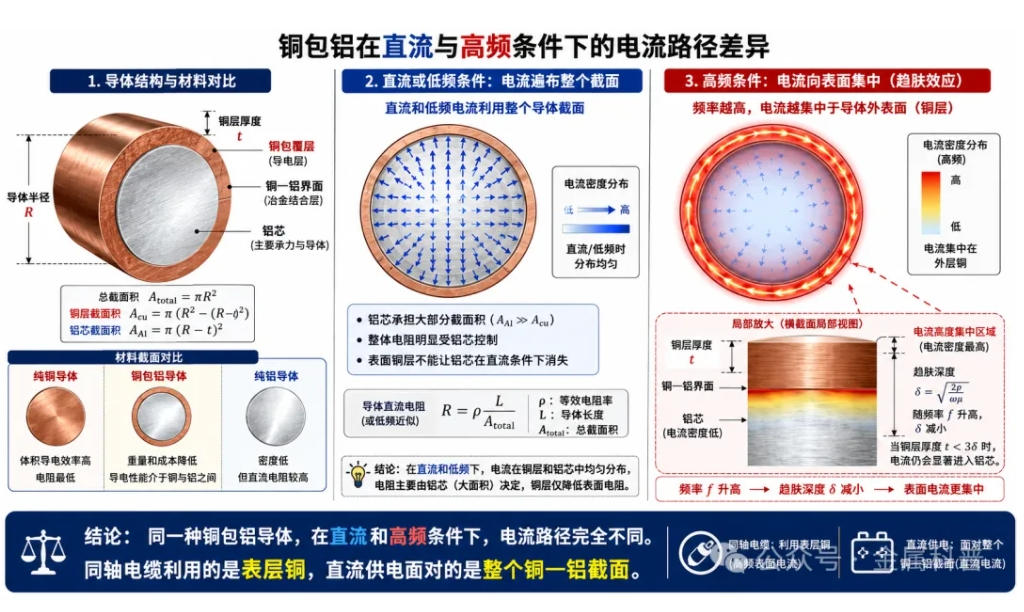
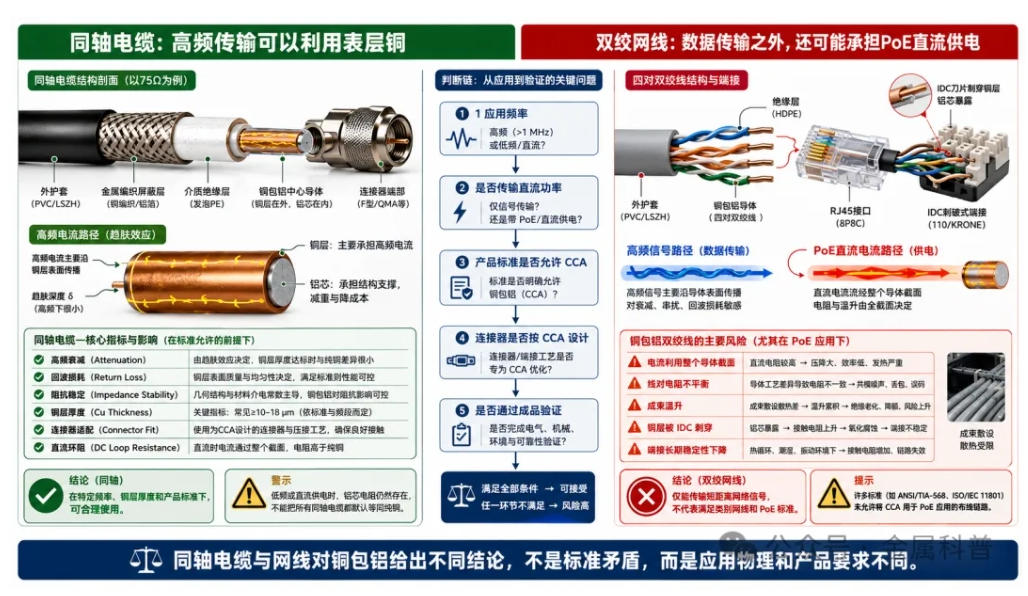
Coaxial cables are primarily used for RF and broadband signal transmission. As frequency increases, the skin effect causes AC current to become increasingly concentrated near the surface of the conductor, allowing the outer copper layer to carry a significant portion of the high-frequency current. The aluminum core is mainly used to reduce weight and lower costs.
UL’s cable application guidelines clearly indicate that copper-clad aluminum (CCA) can be used as a center conductor material in certain coaxial cable structures [4]. This application does not mean that CCA is electrically identical to pure copper. Instead, it is because the product design, operating frequency, center conductor dimensions, connectors, and attenuation requirements have been specifically matched to the characteristics of this material.
However, the statement that “CCA is suitable for certain coaxial cables” depends on three important conditions:
-
The operating frequency must be high enough for the current concentration effect within the copper layer to provide practical benefits;
-
The copper layer thickness, continuity, and circumferential uniformity must be sufficient to cover the main current-carrying region;
-
The finished cable must be verified based on coaxial cable performance requirements, including attenuation, return loss, DC resistance, and mechanical reliability, rather than simply comparing a piece of bare wire.
In low-frequency control applications, DC power transmission, or coaxial systems that require the center conductor to carry relatively high current, the higher resistance of the aluminum core will still become a limiting factor. Therefore, the skin effect is not a universal justification that “CCA performs the same as pure copper at all frequencies.”
Coaxial cables accept CCA because the system takes advantage of the conductive properties of the outer copper layer—not because the aluminum core has electrically disappeared.
3. Why Does Controversy Increase Suddenly When CCA Is Used in Ethernet Cables?
Balanced twisted-pair cables not only transmit high-frequency data signals but are also increasingly used for PoE DC power delivery. Signal attenuation, impedance, and crosstalk are certainly important, but power current flows through the entire conductor cross-section, meaning the higher DC resistance of CCA cannot be hidden by the skin effect.
ANSI/TIA-568.2-E is one of the current important standards for balanced twisted-pair telecommunications cabling [6]. Industry testing organizations and copper cabling associations have long pointed out that labeling CCA cables as Category 5e, Category 6, and other standard categories generally fails to meet the corresponding conductor structure, safety certification, and DC performance requirements [8-10].
For PoE applications, the issue is not only the average resistance of a single conductor. The four twisted pairs need to transmit current in parallel. If DC resistance is unbalanced between different conductors or pairs, current distribution will become uneven, resulting in higher temperature rise in certain pairs. Test data from Fluke Networks shows that CCA cables are more likely to significantly exceed limits in DC resistance unbalance tests. Relevant TIA requirements link pair-to-pair and pair balance limitations with loop resistance to control PoE current distribution [8-9].
| Evaluation Aspect | Key Indicators Actually Considered by Standards | Potential Problems Exposed by CCA |
|---|---|---|
| Data transmission | Insertion loss, return loss, crosstalk, propagation delay | Resistance and geometric variations may reduce performance margins |
| PoE power delivery | DC loop resistance, pair-to-pair / pair unbalance | Higher resistance of aluminum core increases temperature rise risks in bundled installations |
| Connector termination | IDC piercing, crimping, and contact stability | Copper layer may be penetrated, exposing aluminum core and making termination consistency more sensitive |
| Safety and identification | Flame rating, cable certification, category labeling | A copper surface does not mean the cable can be labeled as Cat 5e / Cat 6 |
Therefore, in the Ethernet cable field, the key controversy surrounding CCA is not whether it “can transmit network signals.” A non-compliant cable may still appear usable over short distances and at low data rates. The real question is whether it can continuously meet standards under specified lengths, transmission rates, PoE loads, bundled temperature rise conditions, and long-term termination environments.

4. The Copper Layer Is Not a Decorative Layer: Uniformity, Bonding, and Thermal History Together Determine Reliability
Qualified CCA requires continuous copper cladding and stable bonding with the aluminum core. During cold drawing, copper and aluminum have different strength levels, work-hardening behaviors, and elastic responses, while copper layer thickness and interface strain also change with the deformation path. A 2022 nanoindentation study showed that the manufacturing structure of CCA affects the local mechanical behavior of copper, aluminum, and interface regions. Intermetallic compounds formed after heat treatment exhibit high hardness, and the larger the interface region, the greater the potential risk of embrittlement [13].
Copper and aluminum undergo interdiffusion during thermal exposure. Existing studies have identified phases such as Al₂Cu, AlCu, and Al₄Cu₉ at the interface and found that the reaction layer grows with increasing temperature and time [14]. These phases are not simply beneficial in larger quantities: moderate metallurgical bonding helps prevent delamination, but excessively thick and continuous brittle layers reduce toughness and increase electrical resistance. A 2024 study on multi-pass drawn CCA also observed that electrical conductivity reaches a peak under certain annealing conditions and then decreases as the interface diffusion layer becomes thicker [12].
In addition, CCA may still experience creep and stress redistribution under moderate temperatures. Research by Gueydan et al. on fine CCA wires demonstrated that the copper layer, aluminum core, and interface structure collectively influence steady-state creep behavior [15]. This is why high-temperature windings, engine compartments, and long-term high-current applications cannot be evaluated solely based on room-temperature resistance.
From a product perspective, the copper layer must answer at least four questions: Is it continuous? Is it uniform? Is it reliably bonded with the aluminum core? Does it remain stable after processing and thermal aging? Simply scratching the surface with a blade and seeing “copper outside, white inside” only proves that it is a bimetallic conductor; it does not prove that it is qualified CCA.
5. Three Types of Products Must Be Distinguished: Standard CCA, Restricted-Use CCA, and CCA Misrepresented as Pure Copper
| Product Type | Required Basis | Typical Application Boundary | Material Assessment |
|---|---|---|---|
| Standardized CCA bare wire | Copper ratio, resistance, strength, and elongation specified according to ASTM B566 and related standards | Used in products where CCA is explicitly permitted | Normal composite conductor |
| CCA cables validated according to product standards | Overall matching of material, insulation, connectors, and finished product performance | Certain coaxial cables, limited-power applications, or specific electrical uses | Reasonable when conditions are satisfied |
| Products labeled only as “copper core” or CCA marketed as pure copper | Ambiguous material identification; cross-section and resistance often promoted as pure copper | Ethernet cables, audio cables, power cables, and other price-sensitive markets | Information asymmetry and compliance risks |
| Ordinary aluminum wire with copper plating | Copper layer thickness, bonding, and ratio not controlled according to CCA standards | Cannot be considered equivalent to standard CCA based only on appearance | Requires separate testing and evaluation |
The most common misunderstanding is assuming that “CCA is a standardized material” means “any CCA cable is compliant.” The correct logic is exactly the opposite: because CCA is an independent material with clearly defined performance boundaries, products must be designed, labeled, and certified as CCA. Similar material comparisons, such as tinned copper vs copper clad aluminum, also require evaluation based on actual conductor structure, electrical performance, and application standards rather than appearance alone. The copper surface cannot be used to conceal the differences in resistance, termination performance, and thermal stability caused by the aluminum core.
To determine whether a wire is reliable, first check what material and standards it is sold under, then examine the test results; do not judge only by the color of the cross-section.
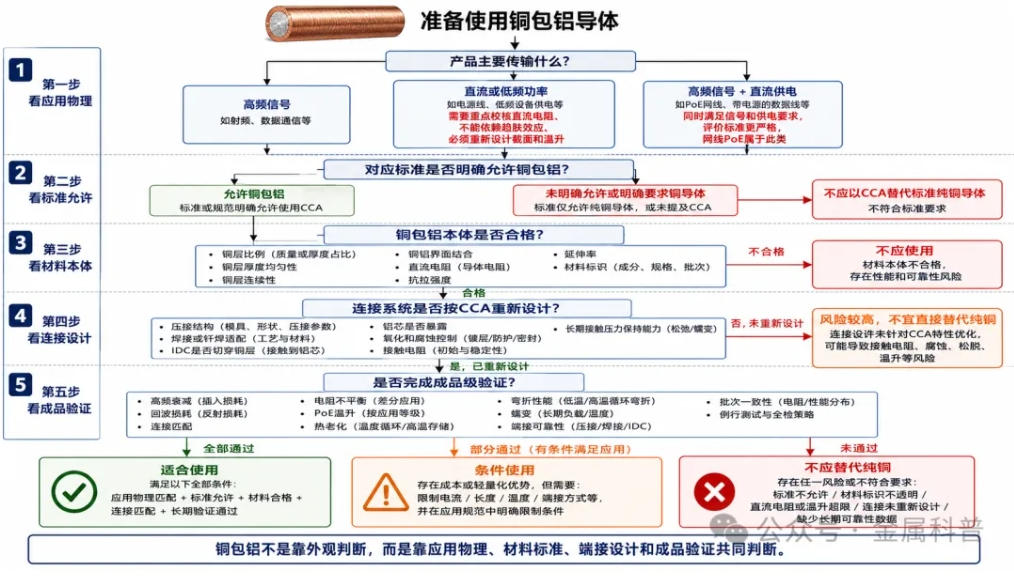
6. Practical Selection Only Requires Asking Five Questions
| Key Question | Evaluation Meaning |
|---|---|
| 1. Does the product mainly carry high-frequency signals, or does it also carry DC power? | High-frequency surface current benefits CCA; DC and PoE applications amplify the resistance disadvantage of the aluminum core. |
| 2. Does the applicable product standard explicitly allow CCA? | The standard boundaries differ between coaxial cables, building wires, limited-power cables, and category Ethernet cables. |
| 3. Is there test evidence for copper layer ratio, continuity, and finished-product DC resistance? | Appearance or supplier statements alone are insufficient. |
| 4. Can connectors cut through the copper layer, and is long-term temperature rise controllable? | Termination areas often reveal problems earlier than the cable body. |
| 5. Has the product completed thermal aging, bending, creep, and batch consistency validation? | Peak performance does not represent long-term reliability. |

7. Conclusion: The Controversy Is Not About Copper-Clad Aluminum Itself, but About Putting the Material into the Wrong System
Copper-clad aluminum can work in coaxial cables because high-frequency current makes greater use of the outer copper layer, and the product structure and performance requirements can be redesigned around this material. However, it faces strong criticism in category Ethernet cables because Ethernet cables not only transmit high-frequency data but also increasingly carry PoE DC power, while being constrained by conductor structure, DC resistance, pair balance, flame retardancy, and certification systems.
Therefore, CCA is neither a “perfect combination of the advantages of copper and aluminum” nor an inherently inferior material. It is a composite conductor with clearly defined application boundaries: when used in the right scenario, it can reduce weight and cost; when used in the wrong scenario, the copper surface may instead conceal the performance differences caused by the aluminum core.
True professional material substitution is not about making a product look more like copper, but about recognizing that it is not pure copper and designing according to CCA’s own resistance, interface, termination, and service-life characteristics.
The different conclusions reached by coaxial cables and Ethernet cables regarding CCA are not contradictory. The determining factors are current paths, product standards, and long-term validation.
Jintian Copper has specialized in copper processing for more than 30 years, producing copper-clad aluminum wire and PEEK wire. Welcome to contact us for consultation. Tel: 0574-83005999, WeChat: 18057437999.

References and Standards
The following materials are used to support the discussions on material structure, standard boundaries, DC resistance, PoE testing, and copper-aluminum interface evolution. The specific scope of application of each standard should be based on the official version and applicable local regulations.
[1] ASTM International. ASTM B566-04a(2025), Standard Specification for Copper-Clad Aluminum Wire.
[2] NFPA. NFPA 70: National Electrical Code, 2023 Edition.
[3] NEMA. Copper-Clad Aluminum Conductor Requirements in the National Electrical Code. Technical Bulletin, 2021.
[4] UL Solutions. Wire and Cable Application Guide. The Code Authority.
[5] UL Solutions. UL 2880, Outline/Standard for Limited-Power Wire and Cable Using Insulated Copper-Clad Aluminum Conductors.
[6] Telecommunications Industry Association. ANSI/TIA-568.2-E, Balanced Twisted-Pair Telecommunications Cabling and Components Standard, 2024.
[7] ISO/IEC. ISO/IEC 11801-1:2017, Information Technology — Generic Cabling for Customer Premises — Part 1: General Requirements.
[8] Fluke Networks. Copper Clad Aluminum (CCA) Cables. Application Note.
[9] Fluke Networks. DC Resistance Unbalance: What You Need to Know. 2025.
[10] Communications Cable and Connectivity Association; Copper Development Association. Warning on Non-compliant Category Cable Made with Copper-Clad Aluminum Conductors.
[11] Czerwinski F. Aluminum alloys for electrical engineering: a review. Journal of Materials Science, 2024. doi:10.1007/s10853-024-09890-0.
[12] Song J W, Hong J P, An Y J, et al. Evaluation of the Mechanical and Electrical Properties of Multistage Drawn Copper-Clad Aluminum Wire After Annealing Process. Metals, 2024, 14(12): 1386. doi:10.3390/met14121386.
[13] Eve S, Keller C, Hug E. Study by nanoindentation of the influence of the manufacturing process on the mechanical properties of Copper-Clad Aluminum wires. Matériaux & Techniques, 2022, 110: 204. doi:10.1051/mattech/2022008.
[14] Gueydan A, Domengès B, Hug E. Study of the intermetallic growth in copper-clad aluminum wires after thermal aging. Intermetallics, 2014, 50: 34-42. doi:10.1016/j.intermet.2014.02.007.
[15] Gueydan A, Hug E. Secondary creep stage behavior of copper-clad aluminum thin wires submitted to a moderate temperature level. Materials Science and Engineering A, 2018, 709: 134-138. doi:10.1016/j.msea.2017.10.044.
[16] Hug E, Bellido N. Brittleness study of intermetallic (Cu, Al) layers in copper-clad aluminium thin wires. Materials Science and Engineering A, 2011, 528: 7103-7106. doi:10.1016/j.msea.2011.05.077.
[17] Sharifian Amiri F, Hosseinipour S J, Jamshidi Aval H, Jamaati R. Fabrication of a novel high-strength and high-conductivity copper-clad aluminum composite wire. CIRP Journal of Manufacturing Science and Technology, 2023, 41: 144-159. doi:10.1016/j.cirpj.2022.12.004.
[18] Sharifian Amiri F, Hosseinipour S J, Jamshidi Aval H, Jamaati R. Evaluation of strength and electrical conductivity of copper clad-AA6063 bimetallic composite wire after annealing treatment. Materials Chemistry and Physics, 2024, 312: 128660.
[19] Lapovok R, Dubrovsky M, Kosinova A, Raab G. Effect of Severe Plastic Deformation on the Conductivity and Strength of Copper-Clad Aluminium Conductors. Metals, 2019, 9: 960.
[20] Moisy F, Gueydan A, Sauvage X, et al. Influence of intermetallic compounds on the electrical resistivity of architectured copper clad aluminum composites elaborated by a restacking drawing method. Materials & Design, 2018, 155: 366-374.
[21] Dashti A, Keller C, Hug E, et al. Experimental and Finite Element Analysis of the Tensile Behavior of Copper-Clad Aluminum Composite Wires. Materials, 2021, 14.
-
Tel:
-
E-mail:
-
Address:
No.1 Chengxi West Road, Cicheng, Ningbo, China
-

Ms.Yu
-

Ms.Sun