 中文

The Global Journey of a Copper Tube: How Jintian JT105 Solved the Corrosion Challenge
A Copper Tube That Perforates Without a Trace
In the heat-pump equipment room of a coastal city, an apparently intact copper tube may be gradually eaten away by invisible formic acid. The industry calls it formicary (ant-nest) corrosion: silent and unobtrusive, yet it often triggers a sudden leak midway through the equipment’s service life.
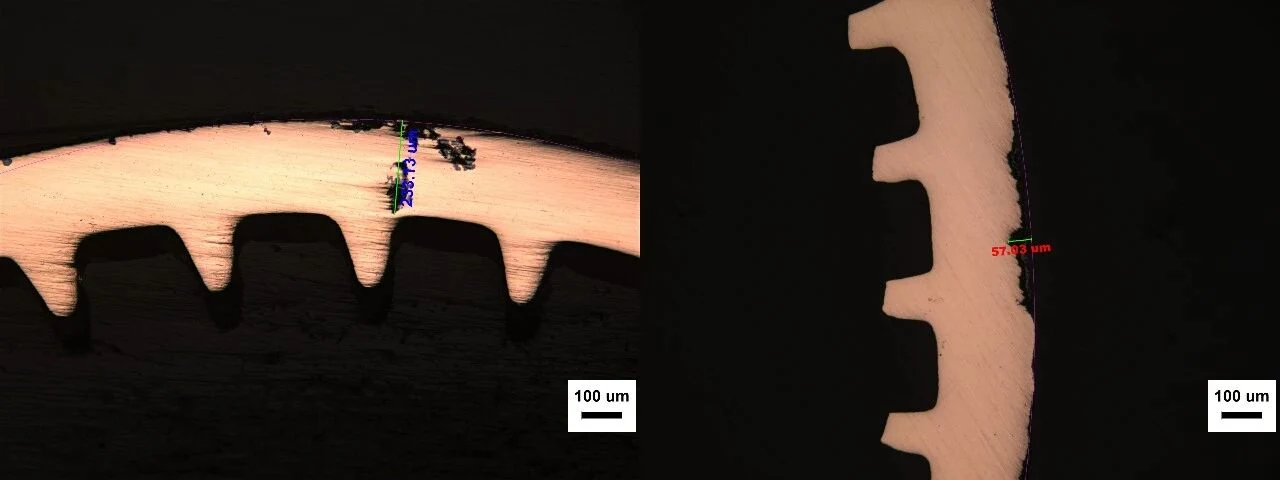
Left: a conventional old copper tube damaged by formicary corrosion; Right: under identical operating conditions, the Jintian JT105 tube significantly extends equipment service life.
This is exactly the weak point of conventional TP2 phosphorus-deoxidized copper tube. As heat pumps and commercial refrigeration shift toward high-pressure, environmentally friendly refrigerants, and equipment becomes smaller with thinner walls, the old tube’s shortcomings—unable to resist, unable to last—are amplified. Long service life and high reliability have become a hurdle facing the industry. Jintian’s R&D team set out to tackle the problem head-on.
Breaking the “Impossible Triangle”
Heat and corrosion resistance, thermal conductivity, and formability were once the “impossible triangle” of copper tube materials: hard to achieve all at once. JT105’s solution was neither thicker reinforcement nor repeated parameter tuning on the production line. Instead, the R&D paradigm was moved upstream: a three-dimensional drive of “dataset + mechanism model + AI agent” carries out multi-objective optimization of composition–process–microstructure–properties in the digital space, before returning to the line for validation.
Drawing on a full-link dataset and the CPSP data chain, the team distilled composition–process–microstructure–property knowledge into a computable foundation; physical metallurgy knowledge was embedded in the mechanism model so that predictions remain explainable and traceable. Three linked agents—requirement conversion, formulation recommendation, and process recommendation—form an agile closed loop from requirement parsing to solution generation.
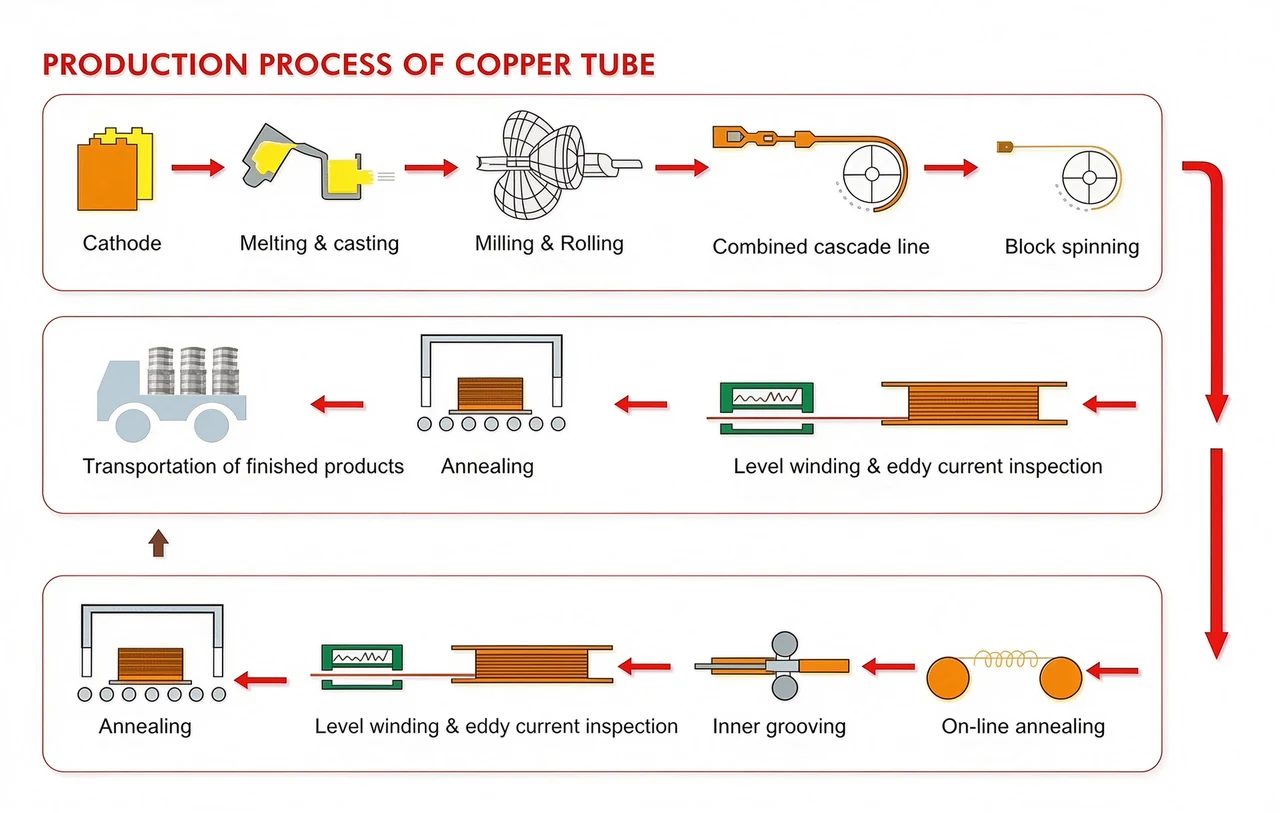
Production process of copper tube.
Five years of R&D effort condensed into four coordinated technologies: adding controlled alloying elements to block corrosion at the source; resolving the poor plastic-forming defects of alloy tube so thin-wall, small-diameter tubes run stably and remain compatible with existing lines; using thermomechanical microstructure control to relieve fatigue risk under high-pressure cycling; and precisely controlling inner-wall residual oil and roughness so corrosion has nowhere to settle. Heat/corrosion resistance, conductivity, and formability thus move from mutual restraint to coordinated improvement.
The formulation design cycle was cut from six months to 30 days, and first-trial sample success rose from 30% to 90%. Beyond delivering one high-performance copper tube, JT105 demonstrates that Jintian Copper has the capability to solve complex material problems systematically with data, models, and AI agents.
Proven by Data, Proven by the Market
Whether the story is convincing and the technology holds up ultimately comes down to two gates: data and the market.

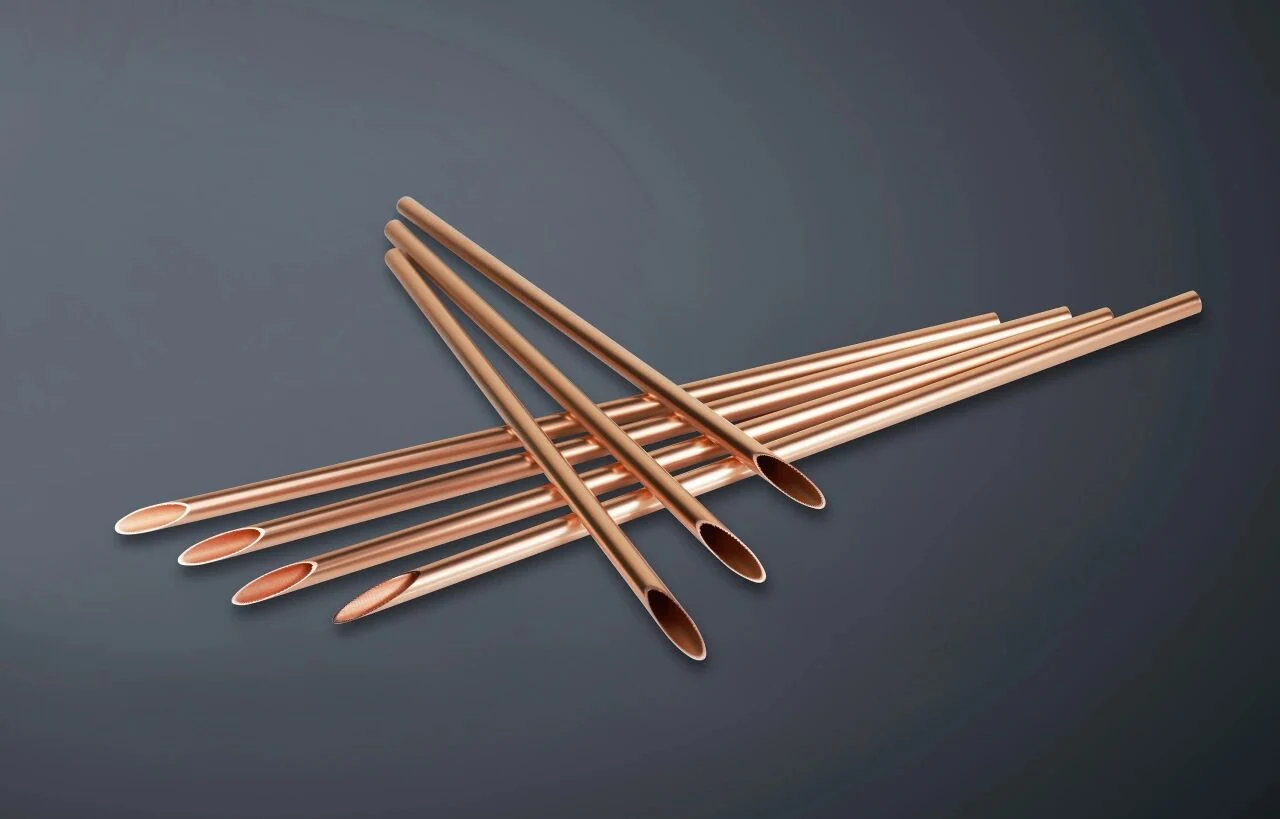
Jintian JT105 copper tubes.
In a formic-acid accelerated corrosion environment, JT105 lasts more than five times longer than conventional TP2; its elongation is no less than 40%, giving easy tube-expansion formability; inner-surface roughness is controlled to Ra≤1.5μm and residual oil to ≤20mg/m². Behind every figure is a rigorous pursuit of “reliability”.
JT105 now serves six application areas: air-source heat pumps, new-energy vehicle thermal management, data-center liquid cooling, energy-storage temperature control, commercial multi-split (VRF) systems, and special industrial refrigeration, quietly serving as heat-exchange and connecting tubes. It has entered premium customers’ supply chains, matching the performance of phosphorus-deoxidized copper on related production lines while offering a longer corrosion-resistant life. Both gates—from laboratory metrics to line-level adoption—have been met.
This copper tube, which lets heat pumps “run for several more years”, mechanistically resolves the formicary corrosion perforation that has plagued the industry for years, and recently obtained patent certification from the Japan Patent Office (JPO).
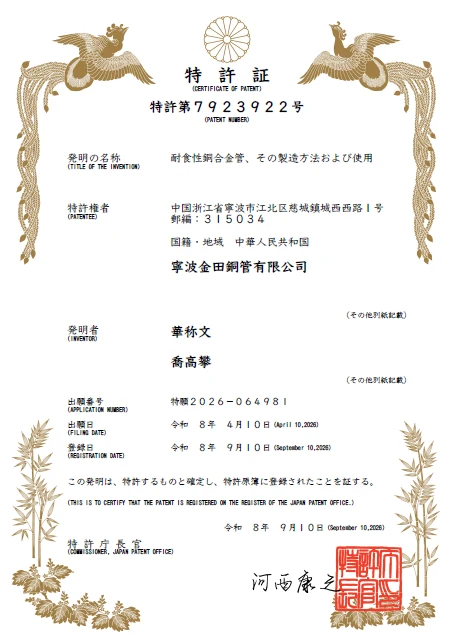
Japan Patent Office (JPO) patent certificate for the corrosion-resistant copper alloy tube, its manufacturing method and use.
The story of one copper tube continues. Starting from real industry pain points and maintaining a rigorous attitude, the team turned theoretical feasibility in the laboratory into solid industrial mass production. JT105 leaves behind not only a solution to a corrosion problem, but also a snapshot of Jintian Copper’s product upgrade.
-
Tel:
-
E-mail:
-
Address:
No.1 Chengxi West Road, Cicheng, Ningbo, China
-

Ms.Yu
-

Ms.Sun