
 中文


How Many Copper Alloys Are There? A Practical Guide to Copper and Copper-based Materials
Note: This article surveys copper and copper-based materials—pure copper, brass, bronze, cupronickel, nickel silver, high-strength high-conductivity alloys, precision resistance alloys, contact materials, composites, and cast alloys. It lists typical Chinese and UNS grades for selection and reference only; composition, temper, and acceptance must follow the applicable current standard and product specification.
When people talk about copper alloys, the first reaction is still brass, bronze, and cupronickel. Modern copper materials go well beyond these three: besides high-conductivity oxygen-free copper, there are precipitation-hardened CuCrZr and CuNiSi, seawater-resistant Cu-Ni, arc-resistant CuCr and CuW, and Cu-Ni-Sn for precision elastic components.
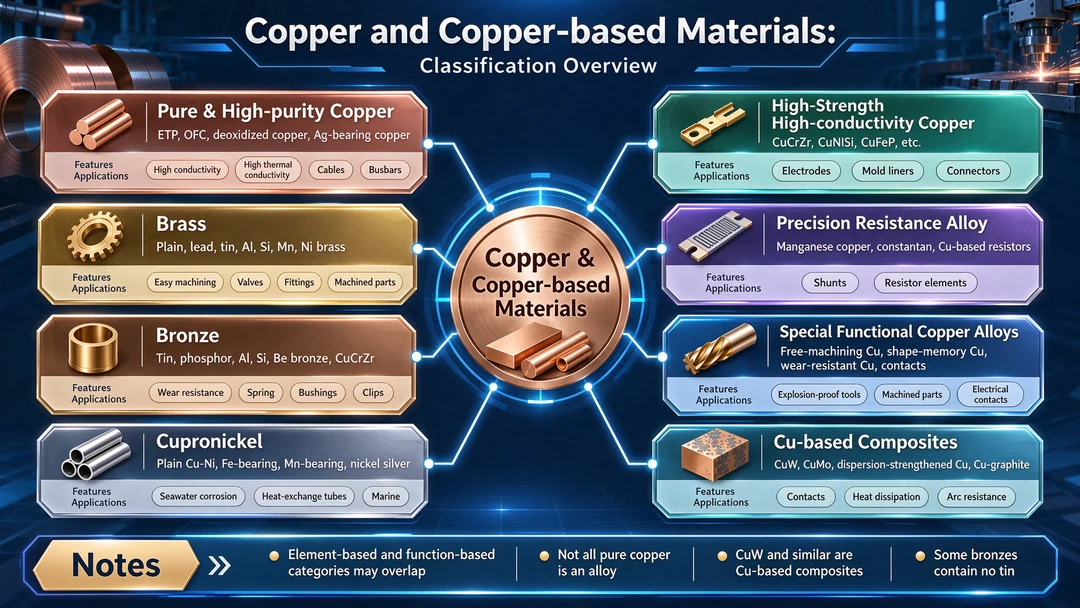
The problem is that these materials are named by alloying element, by performance, or by manufacturing process, and the same material can appear in more than one category. For this reason, “all copper alloys” cannot be fully contained in a single non-overlapping tree diagram.
This article uses a two-layer index. The first layer follows the alloy families used in international material standards: copper, brass, bronze, copper-nickel, and zinc nickel silver. The second layer groups, across families, by high strength and high conductivity, free machining, precision resistance, electrical contact, and copper-based composites. The text covers the main industrial alloy systems, with a typical Chinese/UNS grade index at the end.
Scope note: the UNS copper-alloy database currently lists about 940 copper and copper-alloy entries. This article aims to cover the main alloy systems and make typical grades findable; it does not claim to include every current, withdrawn, experimental, or custom in-house grade in the world.

Figure 1 Classification overview of copper and copper-based materials.
I. Classification Basics: Pure Copper, Brass, Bronze, and Cupronickel
| Traditional term | Core basis | Notes |
|---|---|---|
| Pure / wrought copper | Cu as the main element; includes tough-pitch, oxygen-free, and deoxidized copper | Not all are alloys; some are high-purity industrial copper. |
| Brass | Cu-Zn base system | Complex brass may also contain Pb, Sn, Al, Si, Mn, Ni. |
| Bronze | Narrow sense Cu-Sn; modern industry also includes Al, Si, Be and other “bronzes” | Bronze does not necessarily contain Sn. |
| Cupronickel | Usually the Cu-Ni series | Zinc nickel silver Cu-Ni-Zn, also called nickel silver, usually contains no Ag. |
| Special functional / composite copper | Classified by high strength, high conductivity, wear resistance, electrical contact, or composite structure | May overlap the families above; CuW and similar are composites, not ordinary solid-solution alloys. |
By product form, copper and copper alloys are also split into wrought and cast products. This division is not a quality or grade ladder: the same base system may have both wrought and cast grades, with different impurity limits, manufacturing routes, and acceptance standards.
How to read UNS numbers:
| UNS series | Wrought / Cast | Material range |
|---|---|---|
| C10100–C15999 | Wrought | Pure copper and related low-alloy coppers |
| C16000–C19999 | Wrought | High-copper alloys |
| C20000–C49999 | Wrought | Brasses |
| C50000–C69999 | Wrought | Bronzes (Sn, Al, Si, etc.) and some other systems |
| C70000–C73499 | Wrought | Copper-nickel and related alloys |
| C73500–C79999 | Wrought | Cu-Ni-Zn (nickel silver / zinc nickel silver) |
| C80000–C83299 | Cast | Cast copper and high-copper alloys |
| C83300–C89999 | Cast | Cast brasses |
| C90000–C95999 | Cast | Cast bronzes |
| C96000–C97999 | Cast | Cu-Ni and nickel silver castings |
| C98000–C98999 | Cast | Lead-bearing copper |
| C99000–C99999 | Cast | Special copper alloys |
Source: Copper Development Association (CDA) UNS chemical-composition datasheets. The UNS number is a material identification method, not a standalone product specification; actual composition and properties must be checked against the applicable standard version.
II. Pure Copper, High-purity Copper, Deoxidized Copper: Why Performance Differs
The most important difference is not color, but control of oxygen, phosphorus, and trace impurities. Tough-pitch copper offers high conductivity and good processing economy; oxygen-free copper suits applications sensitive to oxygen and gas release; phosphorus-deoxidized copper has good soldering and brazing adaptability, but residual P lowers conductivity to some degree. Some silver-bearing coppers are micro-alloyed high-conductivity materials and should not be treated as pure copper by name alone.
| System | Representative grade / material | Main features and applications |
|---|---|---|
| Electrolytic tough pitch (ETP) | T2; UNS C11000 | Wire, busbar, rod, general electrical and heat-exchange parts |
| Oxygen-free (OF) | TU1/TU2; UNS C10200 | High conductivity, vacuum devices, clean-melting applications |
| High-purity oxygen-free electronic (OFE) | UNS C10100 | High purity, vacuum electronics, special electronic use |
| Phosphorus-deoxidized (DHP/DLP) | TP2/TP1; UNS C12200 / C12000 | Copper tube, heat exchange, brazing; conductivity verify by grade |
| Ag-bearing / micro-alloyed copper | UNS C10400, C10500, etc. | High conductivity with improved softening resistance or heat resistance in specific conditions |
| Free-machining tellurium copper | UNS C14500 | Improved chip breaking; precision terminals, electrical connectors |
| Free-machining sulfur copper | UNS C14700 | Improved machinability; specific electrical parts |
An easily misunderstood point: high purity is not the best choice in every case. High-purity copper usually conducts electricity and heat well, but where high-temperature load, wear resistance, or higher strength is required, controlled additions of Cr, Zr, Ni, Si and similar elements are more appropriate.
III. Brass: More Than H62 and H65
Brass is based on Cu-Zn. Raising the Zn content generally changes strength, workability, and microstructure; plain alpha brass and alpha+beta brass have different forming windows. Adding Pb, Sn, Al, Si and other elements serves free machining, corrosion resistance, wear resistance, or strength. Names such as “naval brass” and “manganese bronze” carry historical naming backgrounds; when purchasing, return to the chemical composition.
| Subclass | Representative grade / system | Core characteristics | Typical use |
|---|---|---|---|
| Plain alpha brass | H90, H80, H70, H68; C23000, C26000 | Cold working, deep drawing, ductility | Cartridge cases, heat sinks, strip, decoration |
| Higher-Zn brass | H65, H62, H59; C28000 | Balanced strength, cost, and workability | Rods, valves, structural parts |
| Lead brass | HPb59-1; C36000, C37700 | Free machining; watch environmental and use limits | Machined rod, valve bodies, hardware |
| Lead-free / low-lead brass | C69300 silicon brass, etc. | Lead-free machining and corrosion resistance per grade | Drinking-water fittings, precision valves |
| Tin brass / naval brass | HSn70-1; C46400 | Improved corrosion resistance in certain environments | Seawater parts, heat-exchange equipment |
| Aluminum brass | HAl77-2; C68700 | Surface film and corrosion resistance | Condenser tubes |
| Silicon brass | Cu-Zn-Si series | Corrosion resistance, strength, or lead-free design | Sanitary fittings, valves, corrosion-resistant parts |
| Manganese brass / high-strength brass | Cu-Zn-Mn or Cu-Zn-Mn-Al | Strength, wear, and corrosion orientation | Gears, bearings, marine parts |
| Nickel brass | Cu-Zn-Ni | Strength, corrosion resistance, or appearance | Precision elastic parts, decorative and industrial parts |
| Iron brass / complex brass | Cu-Zn-Fe multi-element system | Structural strengthening, wear, process tuning | Special mechanical parts |
| Arsenical brass | Trace-As dezincification-resistant brass | Improved dezincification resistance in specific media | Tube and heat-exchange use |
Counter-intuitive point: brass is not simply “more Zn means higher strength.” High Zn changes phase composition and machinability; some grades also require attention to stress-corrosion cracking (season cracking) and selective dezincification. In use, check alloy microstructure, temper, and environment together.
IV. Bronze: Tin Bronze Is Only One Kind
Traditional bronze is Cu-Sn, but in modern engineering “aluminum bronze,” “silicon bronze,” “beryllium bronze,” and “chromium bronze” are also widely used. Their strengthening mechanisms can be quite different: some rely on solid solution and cold working, some on age precipitation, and others on multi-phase structure and wear resistance.
| Subclass | Grade / system | Features | Application |
|---|---|---|---|
| Tin bronze | QSn6.5-0.1, QSn4-3; C51000, C52100 | Elasticity, wear, corrosion | Springs, connectors, bushings |
| Phosphor bronze | Cu-Sn-P; C51000, C52100 | Fatigue resistance, elasticity, workability | Elastic terminals, clips, precision strip |
| Lead tin bronze | ZCuSn5Pb5Zn5; C93200 | Friction reduction, bearing performance | Bearings, plain bushes |
| Aluminum bronze | QAl9-4; C95400 | Higher strength, wear, corrosion | Marine machinery, gears, valves |
| Nickel aluminum bronze | Cu-Al-Ni-Fe; C63000, C95500 | High strength, seawater and cavitation resistance | Propellers, marine valves |
| Silicon bronze | QSi3-1; C65500 | Corrosion resistance, workability, joining | Fasteners, corrosion-resistant structures |
| Beryllium copper / beryllium bronze | QBe2; C17200, C17510 | Strong age hardening, outstanding strength and elasticity | High-end elastic parts, tools, connectors |
| Chromium copper | Cu-Cr; C18200 | Precipitation strengthening, high conductivity, softening resistance | Electrodes, contacts, welding electrodes |
| Zirconium copper | Cu-Zr; C15000 | Micro-alloying, softening resistance | Electrical, high-temperature parts |
| CuCrZr | Cu-Cr-Zr; C18150 | Balanced strength, thermal/electrical conductivity, softening resistance | Continuous-casting mold liners, welding electrodes |
| Titanium copper | Cu-Ti series | Age hardening, high-strength elasticity | Clips, connectors |
| Ni-Si copper | Cu-Ni-Si; C70250, etc. | Ni-Si precipitate strengthening | High-speed connectors, lead frames |
| Fe-P copper | Cu-Fe-P; C19400 | Fe-related strengthening balanced with conductivity | Lead frames, electronic copper strip |
In industrial naming, some high-copper alloys are loosely called “bronze,” but in UNS or other standard classifications they may fall under high-copper alloys. The description here follows the materials system and is not a confirmation of the formal GB designation.
Important safety note: when processing beryllium-copper alloys, control possible beryllium-containing dust and fumes; occupational health requirements must not be set aside because of high strength and elasticity.
V. Cupronickel: More Than a “Silvery Copper”
The usual cupronickel is Cu-Ni. Raising the Ni content clearly improves service performance in certain corrosive environments; some cupronickels also add Fe, Mn, Cr to adjust seawater corrosion resistance and mechanical properties. “Zinc nickel silver / nickel silver” is a Cu-Ni-Zn system; although called nickel silver, it usually contains no silver.
| Subclass | Grade / composition example | Main function |
|---|---|---|
| Plain Cu-Ni | B10, B30; UNS C70600 (90Cu-10Ni), C71500 (70Cu-30Ni) | Seawater condensers, heat exchangers, marine piping |
| Fe-Mn strengthened Cu-Ni | BFe10-1-1, BFe30-1-1; Cu-Ni-Fe-Mn | Improved erosion-corrosion resistance in seawater |
| Special Cu-Ni-Cr | C72200, etc. Cu-Ni-Cr | Corrosion resistance and specific strength requirements |
| Zinc nickel silver / nickel silver | BZn series; C75200, C77000 | Silvery appearance, elasticity, decoration or devices |
| Manganese cupronickel / resistance cupronickel | Cu-Ni-Mn, constantan type | High resistivity and temperature-response design |
| Ni-Sn copper | Cu-15Ni-8Sn; C72900 | Spinodal strengthening, high strength, wear and elasticity |
Note: Cu-Ni-Sn is grouped in the UNS Cu-Ni related series; its high strength comes from a special age-hardened structure and cannot be selected using the logic for ordinary seawater Cu-Ni tubing.
VI. High-strength High-conductivity, Precision Resistance, and Special-function Copper: Beyond the Traditional Four
Functional categories are defined by “what engineering problem the material solves,” and they inevitably overlap with brass, bronze, and cupronickel classified by main alloying element. This group shows where the copper industry has moved from pure conduction toward high-reliability functional components.
| Functional category | Common material system | Performance design logic | Typical use |
|---|---|---|---|
| High-strength high-conductivity copper | Cu-Cr, Cu-Cr-Zr, Cu-Ni-Si | Precipitation strengthening while reducing matrix solute scattering | Connectors, electrodes, mold liners |
| High-temperature softening-resistant high-copper | Cu-Ag, Cu-Zr, Cu-Mg and related systems | Micro-alloying, thermal stability and conductivity together | Contact wires, electrical materials |
| Lead-frame copper alloy | Cu-Fe-P, Cu-Ni-Si | Strength, conductivity, workability, surface quality balance | Power devices, semiconductor packaging |
| High-elasticity beryllium-free alloy | Cu-Ni-Sn, Cu-Ti | Age structure and stress-relaxation design | Clips, connectors, bearings |
| Precision resistance material | Cu-Mn-Ni (manganese copper), Cu-Ni (constantan) | High resistivity, low temperature coefficient / stability | Shunts, precision resistors |
| Free-machining high-conductivity copper | Cu-Te, Cu-S | Improved chip breaking, not a pure conductivity boost | Terminals, precision copper parts |
| Shape-memory Cu alloy | Cu-Al-Ni, Cu-Zn-Al | Martensitic transformation and reversible deformation | Research actuators and functional elements |
| Arc-resistant electrical contact | CuCr25, CuCr50 and other Cu-Cr two-phase materials | Conductivity balanced with anti-welding and arc erosion | Vacuum interrupter contacts |
| Special high-wear alloy | High-Sn bronze, nickel aluminum bronze, Cu-Ni-Sn | Wear, load, friction-pair fit | Bushings, mechanical and marine parts |
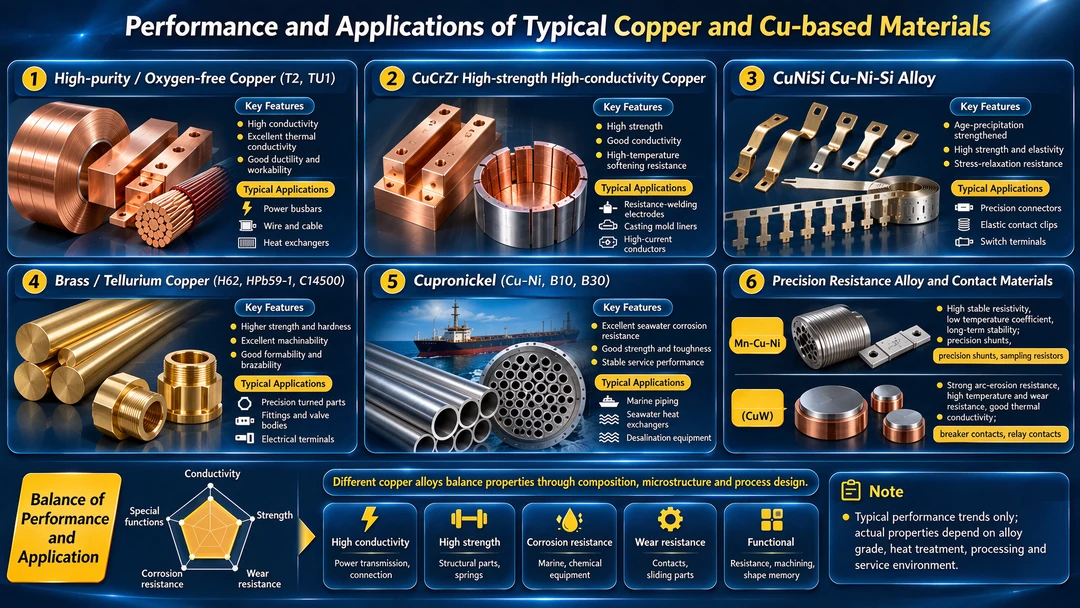
Figure 2 Performance characteristics and industrial applications of typical copper and Cu-based materials.
Counter-intuitive point: aging does not necessarily soften copper. For precipitation-strengthened alloys such as CuCrZr and CuNiSi, proper aging can precipitate strengthening phases while reducing solute in the copper matrix, so strength or hardness and conductivity may rise together.
Another counter-intuitive point: higher resistivity does not mean a worse material. Manganese copper, constantan and similar materials are designed for stable resistance; their value lies in maintaining predictable resistance under temperature and stress, rather than having the highest conductivity.
VII. Copper-based Composites: Named with “Copper,” but Not Always a Traditional Copper Alloy
CuW, CuMo, dispersion-strengthened copper, Cu-graphite, and Cu-diamond are usually produced by powder metallurgy, infiltration, or composite manufacturing to achieve functional synergy. They fall within the “copper-based materials” discussion but should not be confused with a single Cu solid solution or a conventional cast copper alloy.
| Composite | Structural features | Application focus |
|---|---|---|
| Cu-W (copper tungsten) | W skeleton combined with Cu in a composite structure | Arc resistance, high temperature, electrical contacts, thermal management |
| Cu-Mo (copper molybdenum) | Mo-Cu composite tuning thermal conductivity and expansion | Electronic packaging, thermal management |
| Cu-Al2O3 dispersion copper | Ultra-fine oxide particles dispersed in the Cu matrix | High-temperature strength balanced with conductivity |
| Cu-graphite | Copper combined with a solid lubricant phase | Brushes, friction materials |
| Cu-diamond | High-thermal-conductivity reinforcement and interface thermal-resistance engineering | Advanced thermal management, electronic packaging |
| Cu/Al bimetal | Layered or composite Cu-Al conductor | Conductive structure, weight and cost trade-off |
| Cu/steel composite | Copper conductivity and corrosion combined with steel load-bearing capacity | Composite conductors, engineering structures |
VIII. Cast Copper Alloys: Cast Grades Are Not the Same as Wrought Products
Large valve bodies, bearing housings, wear sliders, and marine propellers often use cast copper alloys. These grades place more weight on casting fluidity, feeding, microstructure defects, wear and load capacity, and post-cast heat treatment; wrought copper strip or wire standards cannot be applied directly.
| Cast system | Common China / UNS example | Typical part |
|---|---|---|
| Cast tin bronze | ZCuSn10P1; C90300 | Wear parts, bearings, gears |
| Cast lead tin bronze | ZCuSn5Pb5Zn5; C93200 | Plain bearings, bushes |
| Cast aluminum bronze | ZCuAl10Fe3; C95400 | Wear gears, valve bodies |
| Cast nickel aluminum bronze | ZCuAl10Fe5Ni5; C95500 | Marine propellers, pumps and valves |
| Cast brass | ZCuZn series; C83600, C85700 | Valve bodies, fittings, decorative parts |
| High-strength manganese bronze (historical name) | C86300, etc. high-strength cast brass | High-strength wear mechanical parts |
| Cast Cu-Ni and nickel silver | C96000–C97999 by series | Marine, corrosion-resistant and special castings |
Special note: the Chinese grade and American UNS in the same row show similar material only; they are not one-to-one composition equivalents or direct substitutes. Procurement and grade substitution must compare element limits and product condition clause by clause against the full standard.
IX. Selecting by Application: Do Not Judge Only by Color or Grade
| Actual need | Preferred material direction | Must also verify |
|---|---|---|
| High electrical / thermal conductivity | ETP copper, oxygen-free copper, suitable Ag-bearing copper | Purity, oxygen, gas release, softening temperature |
| Connector clips | Phosphor bronze, CuNiSi, CuNiSn, Be copper, CuTi | Yield strength, stress relaxation, conductivity, surface |
| Resistance shunt | Manganese copper, constantan, etc. | TCR, temperature range, long-term stability |
| Precision machined electrical parts | Tellurium copper, sulfur copper, free-machining brass | Lead limits, chips, conductivity |
| Seawater heat exchange / piping | CuNi10, CuNi30, aluminum brass, etc. | Flow velocity, deposits, erosion-corrosion, joints |
| Wear bushes | Tin bronze, lead tin bronze, aluminum bronze | Load, lubrication, friction pair, casting defects |
| Resistance-welding electrode | CuCrZr, CuCr and other high-copper alloys | Softening, thermal conductivity, strength, cooling |
| Vacuum interrupter contact | CuCr25, CuCr50 and composite systems | Arc erosion resistance, anti-welding, vacuum outgassing, breaking capacity |
| Electronic packaging and thermal management | CuMo, CuW, Cu-diamond, etc. | Thermal expansion, interface thermal resistance, reliability |
| Complex low-cost machined parts | Plain / free-machining brass and other copper alloys | Machinability, corrosion, lead limits, cost |
X. Eight Common Mistakes in Copper-alloy Classification
1. Calling all pure copper an alloy: many pure copper materials are high-purity industrial copper—copper material, but not necessarily an alloy.
2. Assuming all bronze contains tin: aluminum bronze, silicon bronze, and beryllium bronze do not require tin as an essential element.
3. Assuming cupronickel or nickel silver contains silver: nickel silver is usually Cu-Ni-Zn; the name reflects appearance, not Ag content.
4. Treating functional classes such as “high-strength high-conductivity” or “precision resistance” as fully separate chemical classifications: these sets overlap.
5. Treating CuW and CuCr as the same ordinary solid-solution alloy: CuW is usually a metal composite; high-Cr contacts are often two-phase materials.
6. Treating Chinese and foreign grades as a translation of the same number: similar composition may still not be directly substitutable because of standard and product condition differences.
7. Assuming high-conductivity copper suits every condition: wear resistance, softening resistance, corrosion resistance, elasticity, and manufacturability also determine engineering suitability.
8. Treating properties as determined by composition alone: cold rolling, hot working, solution treatment, aging, as-cast defects, and surface condition all change the final properties.
Conclusion: A Real Copper-alloy “Map” Should Guide Selection
From basic oxygen-free copper and brass to high-performance CuCrZr, CuNiSi, CuNiSn, manganese copper, CuW, and copper-based composites, copper serves more functions than simply “conducting.”
Engineering selection should answer at least four questions: first, what is the main alloy system; second, what strength, conductivity, corrosion resistance, or elasticity is required; third, is the product made by casting, rolling, drawing, aging, or powder metallurgy; fourth, what standard and acceptance items apply to the target product.
Getting these four questions clear is more valuable than memorizing hundreds of grades. The typical grade index below can be used as a lookup entry, but actual chemical composition and quality grade must always follow the current standard and product technical agreement.
Appendix A: Quick Index of Typical Chinese and UNS Copper-alloy Grades
| System | Domestic grade / Chinese name (example) | UNS or international index (separate example) |
|---|---|---|
| Pure and high-purity copper | T1, T2, T3, TU1, TU2, TP1, TP2 | C10100, C10200, C10300, C10400, C10500, C11000, C12000, C12200 |
| Plain brass | H96, H90, H85, H80, H70, H68, H65, H63, H62, H59 | C21000, C22000, C23000, C24000, C26000, C26800, C27000, C28000 |
| Lead / lead-free free-machining brass | HPb59-1, HPb63-3, silicon brass (check standard by grade) | C35300, C36000, C37700, C69300 |
| Corrosion-resistant special brass | HSn70-1, HAl77-2, silicon brass, nickel brass, manganese brass | C44300, C46400, C68700, C68800, C69000 |
| Tin / phosphor bronze | QSn4-3, QSn6.5-0.1, QSn8-0.3 | C51000, C51100, C51900, C52100, C52400 |
| Aluminum / nickel aluminum bronze | QAl9-4, QAl10-3-1.5, ZCuAl10Fe3, ZCuAl10Fe5Ni5 | C61000, C61400, C63000, C63200, C95400, C95500 |
| Silicon bronze | QSi3-1 | C65100, C65500, C65600 |
| Be copper / high elasticity | QBe2, CuBe, CuTi | C17000, C17200, C17500, C17510 |
| Cr/Zr strengthened copper | CuCr, CuZr, CuCrZr | C15000, C15100, C18150, C18200 |
| High-copper electronic materials | CuFeP, CuNiSi, CuNiSn, CuAg, CuMg | C19400, C19500, C70250, C72500, C72900 |
| Free-machining high-copper | CuTe, CuS | C14500, C14520, C14700 |
| Cu-Ni / marine cupronickel | B10, B30, BFe10-1-1, BFe30-1-1 | C70600, C71000, C71500, C72200 |
| Zinc nickel silver / nickel silver | BZn series | C73500, C74000, C74500, C75200, C76200, C77000 |
| Cast brass / bronze | ZCuSn10P1, ZCuSn5Pb5Zn5, ZCuAl10Fe3 | C83600, C85700, C90300, C93200, C86300 |
| Precision resistance / functional copper | CuMnNi (manganese copper), CuNi (constantan), CuAlNi, CuZnAl | Per dedicated material specification / enterprise standard; cannot substitute by UNS range alone |
| Cu-based composites | CuW, CuMo, Cu-Al2O3, Cu-graphite, Cu-diamond | Grade usually defined by composite and product technical specification |
Index usage limit: domestic grades and the international numbers in the right column are separate “typical examples of the same material class,” not a row-by-row correspondence table. The actual form, temper, and composition of domestic grades follow the relevant national or industry standard; some Chinese names are engineering common names rather than independent grades in GB/T 5231.
Appendix B: Standards, Databases, and Sources
[1] GB/T 5231—2022, Wrought copper and copper alloys—Designation and chemical composition, National Standard Public Service Platform: https://openstd.samr.gov.cn/bzgk/std/newGbInfo?hcno=09970C354C14FFD115E50D77FAE689AA
[2] GB/T 1176—2013, Cast copper and copper alloys, National Standard Public Service Platform: https://openstd.samr.gov.cn/bzgk/std/newGbInfo?hcno=2433BAD869BDE2F6C5B24AEBA6FD39A8
[3] Copper Development Association, UNS Chemical Composition Datasheets: https://datasheets.copper.org/
[4] Copper Development Association, Advanced Search for Wrought and Cast Copper Alloys: https://alloys.copper.org/
[5] International Copper Association, Copper Attributes and Alloys: https://internationalcopper.org/sustainable-copper/about-copper/copper-attributes-and-alloys/
[6] Copper Development Association, Standard Designations for Wrought and Cast Copper Alloys: https://archive.copper.org/resources/standards/uns-standard-designations.php
[7] Copper Development Association, Copper Alloys for Marine Environments (Publication 206): https://www.copper.org/applications/marine/cuni/alloys/pub-206-copper-alloys-for-marine-environments.pdf
[8] ASTM B122/B122M-26, Copper-Nickel-Tin, Copper-Nickel-Zinc and Copper-Nickel Sheet/Plate: https://store.astm.org/b0122_b0122m-26.html
[9] CDA Alloy Database, C72900 Cu-Ni-Sn: https://alloys.copper.org/alloy/C72900
[10] CDA UNS Wrought Copper Index (C10100–C15999): https://uns.copper.org/wrought/coppers.php
Editorial note: classification and typical grades are for educational selection and reference retrieval; this article does not replace the standard text, mill material certificate, performance testing, risk assessment, or customer specification. “Similar material” here is not a standard equivalence commitment.
-
Tel:
-
E-mail:
-
Address:
No.1 Chengxi West Road, Cicheng, Ningbo, China
-

Ms.Yu
-

Ms.Sun